
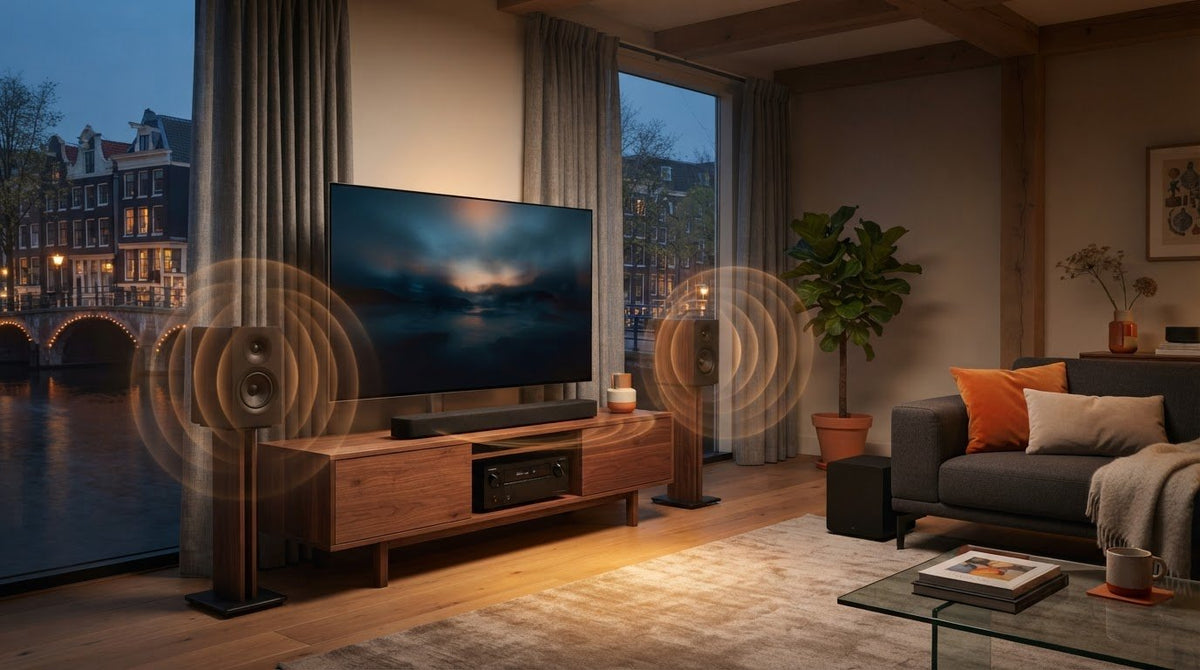
How do you get the ultimate movie night sound at home? Not by simply installing as much equipment as possible. The right setup for your room makes more of a difference than a system that doesn't suit your space. Does the TV sound sound flat, or are you unsure between an soundbar and separate speakers? Then start with your room, your viewing habits and what exactly you want to hear.
A soundbar is compact and easy to install. With a stereo set you use two separate speakers, possibly supplemented with an subwoofer for extra low tones. If you want sound through multiple speakers around your listening position, a surround setup may be suitable. In a 5.1 system, the .1 represents the low effects channel, which is displayed via an subwoofer . Which setup is suitable depends on your room, wishes and equipment.
Discover how speakers, placement and tuning together determine the movie experience. You can read what to pay attention to in a soundbar, stereo or surround setup, what role a receiver and subwoofer play and how to practically arrange the listening position. This way you can choose a solution that suits your home step by step. OrangeAudio sells audio equipment for home use cinema, from speakers and subwoofers to AV receivers.
Key Points
- Discover which setup suits your space and wishes for the ultimate movie night sound at home.
- Compare soundbars, stereo sets and surround setups based on space requirements, ease of use and expandability.
- Identify your equipment, connections and listening needs before choosing a system.
- Check the seating position, the space around your speakers and the cable route to properly fine-tune your setup.
- Choose a system that suits your room and listening preference, rather than automatically going for the largest set go.
Ultimate movie night sound at home: what exactly do you want? hear?
Are dialogues clearly intelligible, but do you miss the impact of a soundtrack? Or does every sound seem to come from the television, while you want to experience more space and movement? TV sound can seem flat, but there is no one setup that works best for everyone. The ultimate movie night sound at home starts with what you want to hear and what your room allows.
Film sound is an interplay of dialogues, sound effects and music. A scene can start quietly with a conversation and then fan out with music or sound moving through the space. Therefore, first determine your listening goal: do you mainly want to hear dialogues clearly, a more spacious sound image or more emphasis on low tones? The room, your seating location and your listening preference determine which setup is suitable.
Which components make movie sound compelling?
In a separate speaker setup, the front speakers help reproduce the music, effects and width of the sound image. In a surround setup, a center channel can display dialogue centrally. This can be useful if you want to follow voices clearly, especially when you are watching with several people. Surround sound depends on the placement and task of multiple speakers. Read more about the basics of surround sound.
An subwoofer supports the low tones in film sound, such as deep sounds and effects. How strong you experience that support depends, among other things, on the space and placement. A subwoofer is therefore not automatically the solution for every sound problem. If you are looking for more clarity, first look at the display of dialogue and the position of your listening position. If you want more spaciousness, investigate whether a setup with multiple speakers suits your room.
Start with your room and viewing habits
Assess your situation before comparing equipment:
- Note where the sofa is and how many seats are important.
- Consider whether you usually watch alone or with several people.
- Write down whether you often watch at low volume or are looking for more impact.
- See how much free space there is around the TV and possible speaker locations.
The listening position counts. A setup that sounds good from one seat may sound different from other seats. If you watch together, take into account the places that are most important to you. This prevents you from only optimizing for a listening position that you hardly use at home. If you want to compare systems further, view the different options for home cinema and determine which direction suits your room and viewing habits.
This is how you build a movie night setup step by step
A good movie setup does not start with one individual speaker, but with the total picture. First map out your viewing wishes and existing equipment. This way you avoid choosing a system that is difficult to connect or that does not fit comfortably in your living room. Use these steps as a route to the ultimate movie night sound at home.
- Make a map of your equipment. Make a note of which TV, streaming source and receiver you already use. Also write down which speakers you want to keep. This way you can see what you already have and what is still missing.
- View the room and your listening needs. Determine where the TV and seating are and how much space is available for speakers. Think about what matters most to you: simplicity, music and effects through separate speakers, or sound that you experience through multiple speakers.
- First choose the type of setup. An soundbar keeps the system compact. A stereo set uses two speakers and can fit if you want a clutter-free setup. A surround setup distributes the sound across multiple speakers, but requires more space, placement and tuning. None of these choices is always the best; your room and wishes are the deciding factor.
- Check connections and compatibility. See which connections are available on your TV, streaming source and possible receiver. Check whether the devices fit together before selecting equipment. Do not assume a connection or function without consulting the documentation of your devices.
- Plan the central equipment. With several separate speakers, an AV receiver can be the central part of the setup. This connects the equipment and sends the sound to the speakers. Which receiver and connections are suitable depends on your system and the devices you want to connect. If you are considering a sound format such as Dolby Atmos, also check whether the equipment and content you use match it.
Choose your source and central equipment
Make a simple list of your TV, streaming source and receiver. Note the connections available for each device and compare them with the connections you need on the other components. This way you discover possible mismatches before you make a choice. View the home cinemacollection if you want to explore different types of equipment for your setup.
Determine how many speakers fit your plans
A compact solution usually requires less space and is easier to place. With separate speakers you have more freedom when putting together, but a surround set requires attention to the location of each speaker and the tuning. If you want to consider a soundbar and bookshelf speakers, compare the use of space, the placement options and what you like to hear.
Soundbar, stereo or surround: which one suits your movie night?
A soundbar, stereo set or surround setup can all suit the ultimate movie night sound at home. The best choice depends on your room, equipment and the location of the speakers. Use this equation as a starting point. Then consider how much space you have and how much freedom you want when putting together and possibly expanding.
| Arrangement | Space | Ease of installation | Expandability |
|---|---|---|---|
| Soundbar | Compact; usually takes up little space around the TV. | A well-organized choice with few loose parts. Check in advance whether the connections and functions suit your TV. | Expanding depends on the options of the chosen system. |
| Stereo set | Requires space for two separate speakers. | You decide where the speakers will be placed. Take connections and the available space into account. | Loose parts provide space to further shape your system later, depending on compatibility. |
| Surround | Multiple speakers require space around the listening position. | The speakers must be carefully placed and matched to each other. | A setup with separate parts can offer opportunities to expand the system, provided the equipment is suitable. |
When does an soundbar suit your viewing habits?
If you like to watch without a lot of separate equipment in the living room, then an soundbar can be a compact solution are. This does not automatically mean that each soundbar fulfills the same role as loudspeakers placed separately around the listening position. Therefore, compare what you find important, such as clear dialogue or a more spacious sound image. Also check which features and connections both your TV and the soundbar support. This way you know in advance whether they fit together.
When are separate speakers or surround interesting?
With separate speakers you can shape the placement and composition of your system yourself. A stereo set may be suitable if you want to use two speakers and want to keep the setup clear. Surround is interesting if you want to reproduce sound through multiple speakers. Keep in mind that each speaker needs a suitable location and that the setup requires more tuning. For practical points of attention when assembling and installing, you can also read the guide from What Hi-Fi? about building a home cinema system to look at.
A subwoofer can supplement low tones, but is not necessary for every room or listening preference. First decide whether extra emphasis on low tones is important to you. Then take a look at the subwoofers for home cinema and see how a model fits in with the rest of your equipment. Do you want to compare different types of systems? Discover the possibilities in the home cinemacollection.

Adjust your movie sound at home with these practical controls
A suitable setup is the start. The location of your couch, the distance to the screen and the layout of the room partly determine how the sound reaches you. Use the listening position where you actually watch films as a starting point. A speaker that sounds good from an adjacent chair won't necessarily sound the same from the couch.
Check these points before adjusting settings:
- Seating position: note where you usually sit and how many seats you want to bring.
- Free space: check whether furniture, curtains or other objects are blocking the sound from the speakers.
- Cable routing: consider where can run cables safely and practically, without hindering your walking route.
- Listening distance: listen from your usual place. The distance to the screen and speakers influences how you experience the balance and spaciousness.
Place speakers relative to your seating area
Use the area around the screen as a starting point for the front speakers, but don't consider that a fixed norm for every room. The layout and available space differ. Place surround speakers according to the directions for your system, around or behind the listening position where appropriate. Then, from your usual sitting position, check whether furniture, walls or curtains are shielding a speaker. If necessary, move slightly and listen again.
Also consider other viewing locations. If several people are sitting in different places, assess the sound from the places that are important to you. Don't just optimize for one ideal seat if it doesn't match how you usually look.
Check dialogues, bass and settings
Test settings step by step. Start with a scene where voices are easy to follow. Are dialogues pleasantly audible from your usual seat? Then listen to a music fragment and a scene with clear effects. This way you will notice whether a change improves the balance or makes it less pleasant. Adjust one setting at a time and follow the manual of your equipment. Then you can better assess what causes the difference.
You can also try out the location of an subwoofer in your own room. Bass sounds can sound different in one place than in another, depending on the room and listening distance. Carefully move the subwoofer to another suitable location and compare the sound from the couch. Start listening before changing any settings.
Want to add bass or check out your existing setup? View the subwoofers for your movie setup and check how a choice suits your equipment and space.
Complete your movie night with equipment that suits you
You don't have to immediately choose the most extensive setup. First make three choices: which film experience you are looking for, which system suits it and where you can place the equipment in your room. This way you can build the ultimate movie night sound at home based on your wishes, instead of from a list of separate equipment.
Use this checklist before choosing equipment
Put your situation on paper before you start comparing. This makes choices clearer and helps you determine what suits your living room.
- Desired viewing experience: do you mainly want to hear dialogues clearly, a more spacious sound image or more emphasis on low tones?
- Available space: note where you sit, how many seats are important and how much space there is for speakers and other equipment.
- Existing equipment: write down which TV, streaming source and receiver you already use.
- Connections: check what your equipment supports and whether the parts you want to combine connect with each other.
- Sequence: determine which parts you need now and which may follow later. Check in advance whether future expansions will work with your system.
A compact solution may fit better in a room where space is limited. Separate speakers offer more freedom to design the setup, as long as you have room for them. So choose not only based on what you would like to hear, but also based on what fits practically in your room.
Discover a solution that suits your needs
OrangeAudio is a specialized provider of audio equipment, including products for home cinema such as soundbars, speakers, subwoofers and AV receivers. When making your choice, consider not only what you need immediately, but also how you want to use the equipment. Check whether the parts fit together. This way you keep the composition clear and prevent you from choosing functions that you do not need.
Do you want to view suitable options side by side? Discover the home cinemaequipment and use your checklist to make targeted comparisons. For broader Hi-Fi selection help, you can also use the Hi-Fi system checklist OrangeAudio view. Step by step, you will find a setup that suits your wishes, equipment and available space.
Give your movie night a sound that suits you
The ultimate movie night sound at home does not start with the largest set, but with your wishes and the room in which you are watching. First choose whether a soundbar, stereo set or surround setup suits your viewing habits. Then check whether your equipment is connected and place the speakers so that they work well from your usual seat.
Test dialogues, music and effects separately and change settings step by step. This way you discover what sounds pleasant in your room. An subwoofer can supplement low tones, but is not a mandatory part of every setup.
OrangeAudio sells audio equipment for home cinema, including speakers, subwoofers and AV receivers. Would you like to further explore the options for your movie night? Discover the home cinemarange from OrangeAudio and compare equipment based on your space and needs. Start with your checklist and choose a setup that suits how you watch movies at home.
Frequently asked questions about home movie sound
Is an soundbar enough for a good movie night at home?
Yes, an soundbar can be enough if you want a compact setup and complement the sound of your television. Whether the result suits you depends on your room, viewing habits and expectations. Check in advance which connections your television and soundbar share. If you want sound through multiple separate speakers or more options to put together your system yourself, then also compare a stereo set or surround setup.
Can I use regular stereo speakers for films?
Yes, you can use stereo speakers for films if you can connect them to a suitable amplifier or other suitable equipment. Two speakers reproduce the sound as a stereo image, so that dialogues, music and effects are heard through that setup. Check whether the connections of your television, source and amplifier match. Place the speakers around the screen and listen from your usual seat to assess the balance.
How do I place speakers for surround sound at home?
Start at your main listening position. Place the front speakers around the screen and position the surround speakers according to your system's directions, usually around or behind the seating area. The exact location depends on the equipment and the layout of your room. Make sure furniture or curtains do not obscure the speakers. Listen from where you watch movies and adjust placement as necessary.
Do I need an subwoofer for movie sound at home?
No, a subwoofer is not necessary for every movie setup. It can support low tones, such as deep sounds in music and effects, but whether you like that depends on your listening preference and the room. Start with your existing speakers and determine if you're missing the bass. If you want to try an subwoofer , check whether it fits your equipment and test different places in the room.
Which is better for films: an soundbar or separate speakers?
That depends on what you find important. A soundbar is compact and requires little separate equipment. Separate speakers give you more freedom to choose the placement and composition and can be interesting if you want to expand later. They do require space and attention for connections. Compare both options from your own viewing position and take into account your equipment, room layout and the number of seats you want to take with you.
How do I improve dialogues during films at home?
First check whether speakers are free and listen from your regular seat. Move them when furniture or curtains block out the sound. Then test with a scene in which voices are easy to follow and adjust settings one by one according to the manual of your equipment. In a surround setup, a center channel can display dialogue centrally. Judge the result at the volume you usually watch, not just during a short test.