
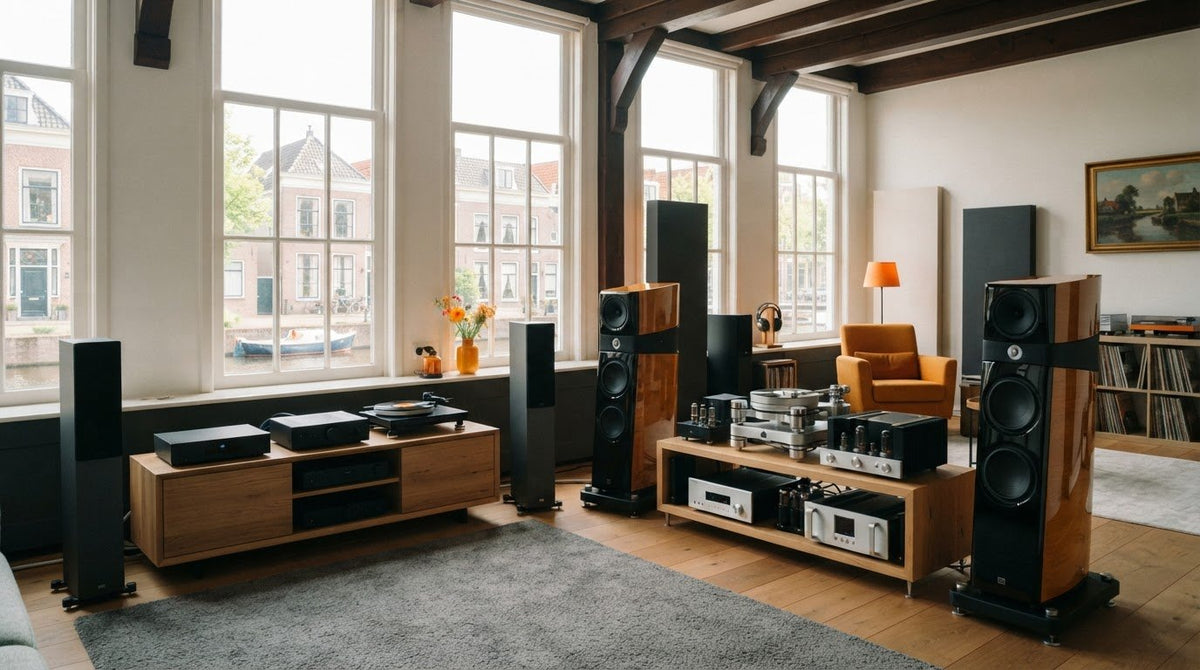
A more expensive audio system is not automatically better suited to your taste or living room. So: what is the difference between hifi and high-end audio? The terms have no fixed boundaries, and technical specifications or a price label do not tell exactly what music sounds like at home.
Do you want to know whether you really hear a difference while listening and what you should pay attention to? In this article you will discover what hifi and high-end audio mean, why the combination of parts counts and what influence it has on your listening room. This way you can judge systems on more than just numbers.
We look at how source, amplifier and speakers together determine the sound. You will also receive practical tools for listening to coherence, detail and comfort. The best set is not necessarily the most expensive, but the one you want to continue listening to.
Key Points
- Discover what is the difference between hi-fi and high-end audio. The terms have no universal technical or financial limit.
- Assess the connection between music source, amplifier and speakers, not just separate specifications.
- Compare hi-fi and high-end as different listening purposes, not as an absolute ranking of quality.
- Use familiar music to quietly pay attention to voices, instruments, dynamics and listening comfort.
- Discover how a system fits your listening preferences during a free demonstration.
What is the difference between hi-fi and high-end audio?
Hifi is a broad term for sound reproduction that makes music sound as natural as possible. High-end emphasizes a refined overall experience, with attention to the choice and coordination of components. Yet there is no universal technical or financial limit that determines exactly when a system is high-end. The answer to the question of what is the difference between hi-fi and high-end audio is therefore not only in the label or the price, but also in how a complete set sounds to you.
Keep three things apart: the name of the manufacturer, the technical properties of equipment and what you actually hear. Specifications can say something about a device, but do not in themselves predict whether voices sound natural or whether music will hold your attention. A higher price tag also does not prove that a set better suits your taste, music or listening room.
Hifi is a broad term for sound reproduction
Hifi is derived from high fidelity, or a high degree of fidelity to the original recording. The ideal is that you hear music clearly, with as little unwanted distortion as possible. Read more about what high fidelity (hi-fi) means. Various systems can pursue that goal: from a compact set with active speakers to a combination of a separate amplifier and bookshelf speakers. The product type or price level does not determine whether something is hi-fi.
The structure can also differ. A set can consist of several separate devices, while an integrated system brings together different functions. Both can be aimed at faithful reproduction. Therefore, do not just look at the shape or the number of parts, but at the performance of the system as a whole and at the music you want to listen to with it.
High-end describes an ambition, not a fixed limit
High-end refers to a pursuit of a refined overall experience. Designers can pay extra attention to component selection, use of materials, construction and the coordination between devices. This does not mean that there is one mandatory structure. A striking feature, impressive specification or luxurious appearance does not automatically make a system high-end.
Hifi is the pursuit of faithful sound reproduction; high-end, the ambition is to further refine that experience with extra attention to design, coordination and experience. That distinction helps, but does not make the terms fixed quality classes. Manufacturers and listeners can use them differently. So see them as indications for an approach, not as a quality mark that guarantees a certain listening experience.
You discover the value of a system by listening critically. Pay attention to how convincing voices sound, whether instruments can be distinguished from each other and whether the music remains pleasant after longer listening. Such impressions are personal. What sounds natural and compelling to you may not be to someone else. The listening experience makes the difference between a label on paper and a set that really suits you.
Which parts determine the quality of a hi-fi or high-end system?
An audio system works as a whole. The music starts at a source, goes through the necessary conversion and amplification to the speakers and then reaches your ears in the listening room. Each part has its own task. The listening experience therefore does not depend on one impressive number, but on how the entire chain works together.
Source, DAC en amplifier: the route from music to sound
Your music source can be, for example, a streamer, record player or other player. In digital music, an DAC converts the digital data into an analog signal that can be reproduced as sound. That conversion can be in a separate device or part of other equipment. It is important that the signal is appropriately passed on to the amplification.
The amplifier receives the audio signal and supplies the energy needed to drive the speakers. The combination counts: an amplifier must match the chosen speakers and the intended use. A power value in itself does not tell you how convincing a set sounds. If you would like to delve deeper into this choice, take a look at the points to consider when purchasing a amplifier hi-fi.
When assessing a set, go through the signal chain step by step. Which source do you use most? Where is the digital signal converted? And how do the amplifier and speakers connect? This way you look beyond a separate specification and investigate how the components work together.
Speakers and listening room together form the display
Speakers convert the amplified signal into sound, but the room changes color as well. The distance from walls, the placement in relation to your listening position and the furnishings can influence how you experience voices, instruments and bass tones. As a result, the same speaker can sound different in two living rooms. The space belongs to the system, not just at the last step.
The format also does not automatically determine what fits best. A floorstanding model may make sense in one situation, while bookshelf speakers may better suit the available space and your style of listening. Larger or more expensive does not automatically mean more suitable. Think about where the speakers will be placed and how far away you are from them.
Do not therefore judge components separately. A source with many options adds little if the rest of the set does not meet your needs. Conversely, a carefully chosen combination of streamer, amplifier and speakers can provide a pleasant, balanced listening experience without each component having the most striking specifications.
That is also the practical core of the question of what is the difference between hi-fi and high-end audio. Look at the complete chain and at the room in which you listen. OrangeAudio helps you explore the categories and combinations, so you can more specifically determine which components suit your music and living room.
Is high-end audio really better than regular hi-fi?
Not automatically. High-end audio may have a different ambition, but that does not automatically make a high-end set better or more pleasant than a well-tuned hi-fi system. So the question what is the difference between hi-fi and high-end audio cannot only be answered with technical data. Listen to what a system does to your music and take into account your preference, the volume and the room in which you listen.
Use this comparison as a guide, not as a fixed ranking. The features are possible listening targets, not a guarantee that every set with a particular label will sound like this.
| Listening purpose | Hifi | High-end |
|---|---|---|
| Coherence | A balanced representation of the music. | Extra attention to the tuning of the entire set. |
| Detail | Instruments and voices can be heard well follow. | Subtle nuances can be more prominent. |
| Dynamics | Music sounds lively and retains contrast. | The reproduction can clearly show small and large differences. |
| Natural reproduction | The sound strives for a believable impression. | The presentation can be further refined or immersive depending on the set. |
What can you compare while listening?
Choose the same music sample and compare systems at a similar volume. Listen to see if you understand the singer's words correctly, where instruments appear to be in the soundstage and whether high, mid and low tones remain balanced. Also notice if a song sounds powerful without being restless. Describe what you hear, not what you think a system should hear.
Use more than one excerpt. A recording with a clear vocal part helps you assess your voices; a song with multiple instruments makes you pay closer attention to placement and coherence. Differences are best judged when the music and volume remain the same. This way you prevent a louder system from seeming more impressive.
Why personal preference outweighs a label
Your taste matters. Maybe you are looking for a lot of audible detail, or a quiet, warm sound that you can listen to for a long time. Music genre and listening volume also play a role: what is pleasant with an acoustic song does not necessarily have to be your preference with heavy rock or electronic music. Therefore, bring different music styles that you know well.
A label describes an ambition, but does not predict whether you will like the sound at home. Pay attention to your own reaction while listening. Keep tuning of course, does the bass sound appropriate and do you want to put on another song? Those are valuable clues. A more expensive set is not automatically the better match. The best choice is the one whose reproduction suits your ears, music and listening room.

How do you assess the difference between hi-fi and high-end audio?
A listening comparison becomes more valuable if you know in advance what you want to pay attention to. So don't start with the label or the technical data, but with your listening goal. Do you want to enjoy a natural singing voice, distinguish instruments well from each other or continue to hear music pleasantly even at a higher volume? Your answer will guide the comparison.
Compare systems with familiar music
Choose a few fragments in advance that you know well. For example, take a song with a clear voice, a recording in which you recognize individual instruments and music with quiet and powerful passages. This way you can compare different aspects of the display. Play the same excerpts with each set and keep the volume as similar as possible. Otherwise, a slightly louder display can quickly seem more impressive.
Listen focused and take short notes. Write down what you notice, without immediately deciding which system wins objectively:
- Can you follow the singer's words well?
- Can you hear where instruments are in the sound image?
- Does the reproduction remain clear when the music becomes busier or more powerful?
- Does the sound still feel pleasant and relaxed after several songs?
Note for example: “the voice sounds close” or “the bass dominates in this song”. Such concrete impressions help you afterwards more than a general judgment such as “this set sounds better”. Listen quietly and repeat an excerpt if you have any doubts. It's about what you observe, not about finding one correct answer.
Translate your listening impression to your own situation
A set that appeals during a comparison must also fit how and where you listen at home. Consider the size and layout of your room, the distance from the speakers, and where you usually sit. Also think about your daily use: do you mainly listen to albums with concentration, or is music often in the background? The same preference may turn out differently in a different room.
Take your choice of music into account. Do you often listen to small acoustic line-ups, electronic music or heavy rock? Use those familiar styles to discover which features are important to you. Also consider which speaker type fits practically: bookshelf, floorstanding or active speakers can each suit a different application. Anyone who wants to combine parts themselves can delve into the approach to putting together a hi-fi system.
The question “what is the difference between hi-fi and high-end audio?” thus takes on a practical meaning: you not only compare equipment, but investigate which combination suits your ears, music and living room. Experience it yourself during a listening appointment or demonstration at OrangeAudio. Plan a listening demonstration and discover what differences you hear.
Experience hi-fi and high-end audio yourself at OrangeAudio
You now have the most important differences and listening points at a glance. The next step is to hear what they mean to you. A demonstration makes your preference more concrete: for example, you can see whether you prefer a quiet display, clearly audible details or a lively presentation. This way, the question what is the difference between hi-fi and high-end audio becomes meaningful in your listening experience, and not just on paper.
Listen to how different systems make your music sound
Bring music that you know well. For example, choose a song with a recognizable singing voice, a track with multiple instruments and a fragment with clear dynamic differences. Familiar recordings make it easier to Brands what you hear, because you don't have to get to know the music at the same time.
Listen at your leisure and give yourself time to discover differences. Ask yourself what appeals to you and what suits you less well. Does a voice sound natural to you? Can you track instruments easily? Does the playback remain pleasant when you listen for longer? There doesn't have to be a winner in the equation. Your own impressions are a useful starting point for a choice that suits your taste.
At OrangeAudio , listening appointments, demonstrations and personal advice are free. OrangeAudio is specialized in hi-fi. Use this opportunity to listen more specifically and ask questions about the components that are relevant to your situation.
From listening preference to suitable components
A preference for a certain sound is only really practical if it matches your daily use. Therefore, discuss how large your listening room is, where you usually sit and what music you often play. Also tell us whether you prefer to choose separate components or are looking for a simpler setup. This creates a more targeted picture of which combination of source, amplification and speakers can suit your needs.
The options vary. Bookshelf and floorstanding speakers take up a different place in your interior; active speakers bring amplification and loudspeaker together in one type of solution. No category is automatically the right choice in itself. Brands as KEF and Devialet can be examples to explore different designs and listening approaches. It's about the match with your music, space and preference.
OrangeAudio helps you listen to the whole and explore the possibilities step by step. Discuss what you find important, from natural voice reproduction to a system that suits your living room and daily use. Schedule a free listening appointment and discover which set makes your music sound in a way that you will happily return to.
Make listening your next step
Make your orientation concrete with a short wish list. Write down what resources you want to use, how much space you have for equipment, and what features you need on a daily basis. Also think about what you want to be able to expand in the long term. This way, when comparing, you keep an eye on ease of use and a setup that suits your home life.
Reviews from buyers can give you additional points of interest, but your own wishes remain leading. Review the experiences with the products you are considering and note any questions that arise. This way you can determine more specifically which options you want to explore further.
Do you want to see which equipment matches your wish list? View the OrangeAudio range and discover which direction suits you. A good choice starts with clarifying what you find important.
Frequently asked questions about hi-fi and high-end audio
Is high-end audio always better than hi-fi?
No. The right choice also depends on how you use your system. If you often listen softly while you work, pay attention to whether music remains pleasant at a low volume. If you mainly use the set for films or parties, other features may be more important. Make a short list of your most important usage moments in advance. This allows you to judge a system on what you actually need, not on an abstract ranking.
When can you call an audio system high-end?
The name is mainly useful as Description of the way in which a system is designed and positioned, not as an official product category with fixed admission requirements. Therefore, look for specific information about the parts, finish, connections and intended application. Ask yourself which features make a difference in your daily use. This way you translate a general indication into points that you can check and compare.
Can a regular hi-fi system sound just as good as a high-end audio?
A hi-fi system can perfectly suit your needs, especially if the equipment suits your sources and use. For example, check which devices you want to connect and whether your set has the correct inputs. Think of a record player, television or streamer. A system that works smoothly with your existing equipment may be more suitable in practice than a more complex setup with functions you do not use.
How do you hear the difference between two hi-fi systems?
Make the comparison as unbiased as possible. Have someone else alternate between systems without telling you which one is playing, and write down your first impressions after each segment. This way you focus on the sound instead of the brand, appearance or price. Then see what differences you notice again during a second listening round. Impressions that come back are more useful for your choice than a one-off response.
What role does the listening room play in high-end audio?
The same room can give a different listening impression in different places. Therefore, try not only your regular seat, but also a place a little closer or further away. Notice if the balance changes as you shift positions. When choosing, also consider practical matters, such as walking routes, furniture and the space you have available for the speakers. This way you prevent a setup from only looking good on paper.
Do you need to have a lot of technical knowledge to choose high-end audio ?
No. Start with practical questions: which sources do you use, how many devices do you want to connect and how do you prefer to operate them? Also note what your current system does well and what you find difficult. With that information you can ask specific questions and put technical terms into context. You don't have to figure out every detail yourself before making an informed choice.
Is it necessary to replace all parts of a hi-fi system at the same time?
No. First check whether your existing components connect to the devices you want to use. For example, look at the available connections and whether your current source works well with the amplification. Also save the details of your current setup. Then, in the event of a change, you can determine what exactly has changed and prevent you from making multiple adjustments at the same time without knowing which one made a difference for you.