
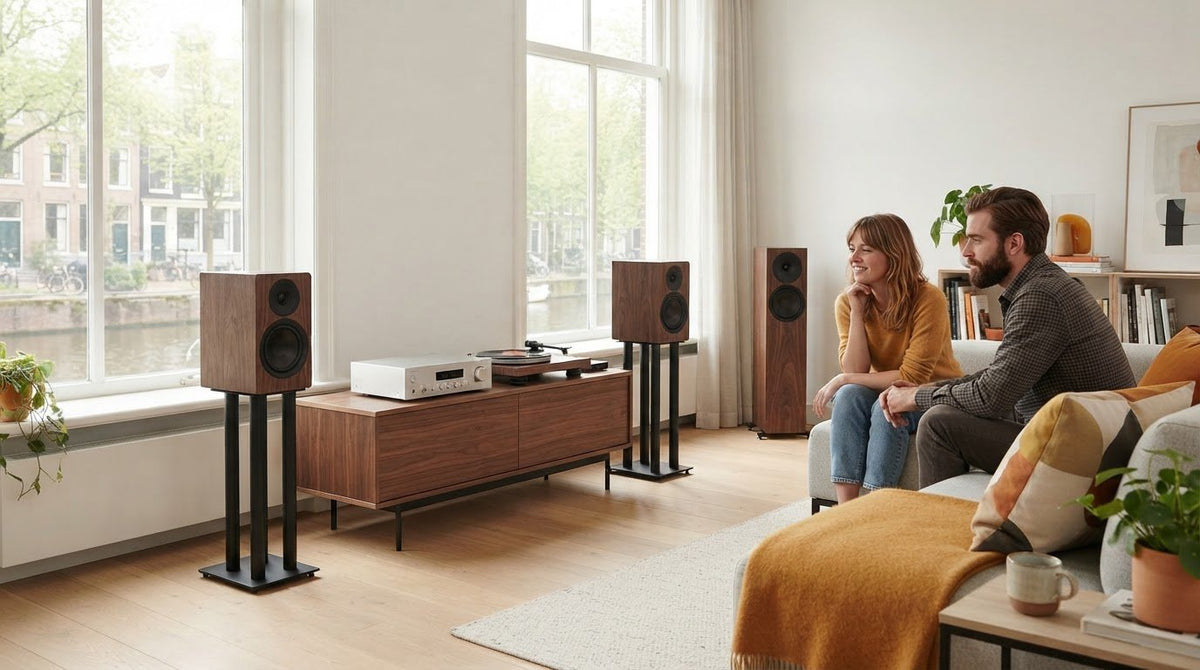
What if the most expensive amplifier or the largest speakers are not the best choice for your first stereo set? Beginner mistakes when buying your first stereo set often arise because you compare individual specifications, while it is the connection between the components and your listening room that counts.
You probably recognize it: technical terms make choosing difficult. An amplifier and speakers may seem attractive separately, but together they may not suit your music, room or listening habits. Therefore, don't start with any device, but with the question of how you want to listen: via streaming, a record player or both?
In this article you will discover which parts make up a stereo set and what each part is for. You will learn how to coordinate the music source, amplifier and speakers , take the size of your room into account and avoid relying solely on wattage, for example.
This way you can compare options with more confidence and choose a system that sounds pleasant in your home, without unnecessary technology. Think ahead, make conscious choices and discover how to put together a first set that can possibly grow with your wishes later.
Key Points
- Recognize beginner's mistakes when buying your first stereo set. Start with your listening needs and avoid choosing parts that don't work well together.
- Discover how the music source, amplifier and two speakers together form your stereo set.
- Compare bookshelf speakers, floor standing speakers and active speakers by space, equipment and placement.
- Follow a practical selection plan and assess possible sets with the same music and under similar listening conditions.
- Use a short checklist for your space, music, source, controls and expandability. OrangeAudio has specialized in hi-fi since 2012.
Which rookie mistakes make your first stereo set unnecessarily complicated?
You see amplifiers, speakers and streamers in all shapes and sizes. Specifications are flying around your head, but which part do you choose first? A common mistake is choosing equipment before you know how you listen and how much space you have. A set may seem attractive on paper, but be clumsy in daily use or not suit your situation.
Also, just paying attention to power or appearance does not provide a complete picture. A higher wattage does not in itself indicate how pleasant a set sounds in your room. Extra functions are only useful if you use them. The gist: a stereo set sounds convincing because of the coherence between the parts, not because of one impressive specification. Do you first want to know how two sound channels together form a spatial sound image? Read what stereo sound is.
Buying a set without first determining your listening needs
Think about your music, your listening moments and your sources. Do you often put on music while cooking, or do you sit quietly to listen carefully to an album? Do you mainly use streaming, or do you also want to connect a record player? Your answers determine which functions are practical and which you do not need.
Also take your sound preference into account. Do you like a quiet, balanced reproduction, or do you want more emphasis on low tones? Write down A pair albums that you know well. This way you will soon be able to assess whether a set suits your taste, instead of basing your choice solely on technical features.
Forget the room, placement and practical space
Measure in advance where the speakers and other equipment can be placed. Take into account the distance between your listening position and the space around the speakers. A large speakers, your listening position and the space around the speakers. A big one speaker must not only fit physically, but also have a suitable location. For example, check out the available bookshelf speakers if you're short on floor space.
The room affects how sound travels. Hard surfaces, furniture and the distance from walls play a role in the listening experience. Therefore, before comparing equipment, make a simple sketch of the room. Mark the possible listening location, sockets and places for the speakers. This way you can see more quickly which setup is feasible.
Use this short inventory as a starting point. This is how you make your wishes concrete before you start comparing models:
- Note what music you often listen to and when.
- Write down which sources you want to use, such as streaming or vinyl.
- Measure the available space and determine where you usually listen.
- Describe in plain words what sound you like.
Many beginner mistakes when buying You can avoid the first stereo set by first looking at your own situation. More equipment or functions do not automatically make a set more suitable. A clear starting point makes comparison easier and helps you choose equipment that you will enjoy listening to in the long term.
How do speakers, amplifier and music source connect?
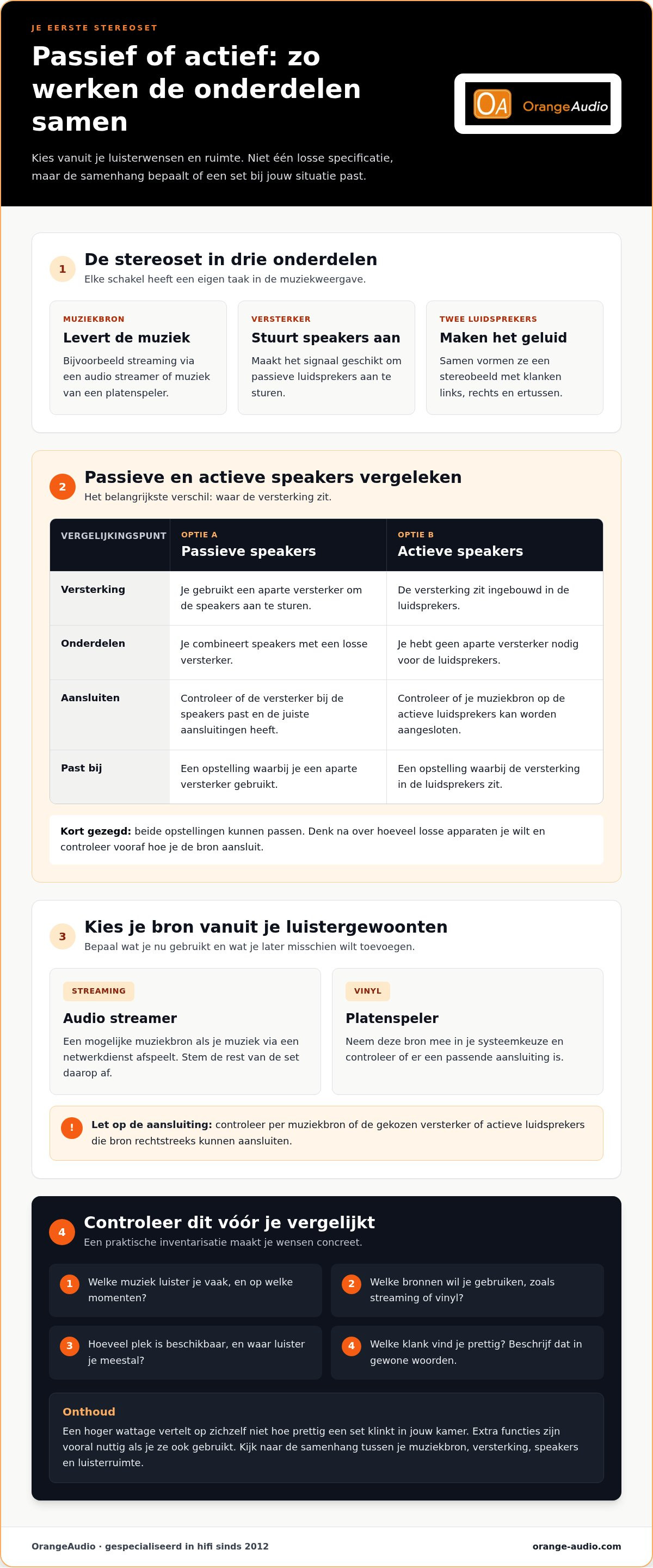
A stereo set consists of three cooperating parts: a music source, an amplifier and two speakers. The source delivers the music, the amplifier makes the signal suitable for driving speakers and the speakers convert that signal into sound. Together, the two speakers create a stereo image, in which sounds are given a place on the left, right and in between.
Do not start with separate specifications. First determine which source you want to use and which type of speakers suits your space and wishes. Then check whether the parts can be connected directly to each other. For example, you avoid choosing a record player while your amplifier does not have a suitable connection.
What role do the speakers and amplifier?
The speakers largely determine the sound character of your set. They differ in how they reproduce music and how they look great in your room. The amplifier forms the link between the source and passive speakers. It drives the speakers , so that music from streaming or another source becomes audible. When choosing an amplifier, pay attention to the connections and the recommendations for the speakers you have in mind.
With passive speakers you need a separate amplifier. Active speakers combine the speakers with built-in amplification. That difference determines how many separate devices you need and how you connect the set. With passive speakers choose a separate amplifier; with active speakers the amplification is in the speakers. Both setups can fit, depending on how much simplicity or freedom you are looking for.
Which source suits how you listen to music?
Your music source is the starting point. If you mainly stream music, an audio streamer can be a useful source. If you like listening to vinyl, then a record player should be part of your system. You don't have to choose just one way to listen: think about what you're using now and what source you might want to add later. Check per source which connections the selected amplifier or active speakers offer.
An audio streamer is relevant when you want to play music via a network service and tune the rest of your set accordingly. Some sets combine streaming and amplification in one device; others use separate parts. When comparing, look at the ease of use you're looking for, not just the number of features.
Before you compare, make a simple diagram: write down your source, note whether you're considering active or passive speakers , and determine which devices provide the amplification. Then check whether the connections match your sources. This order makes the choices clear and helps you put together a set in which the parts complement each other. A beginner's mistake when buying your first stereo set is not only choosing the wrong device, but also forgetting how it fits into the whole.
Discover, for example, how bookshelf speakers can play a role in a compact setup. Compare them with active speakers and a set with a separate amplifier. Choose the construction that suits your listening habits.
Bookshelf speakers, floor standing speakers or active speakers?
The shape of a speaker does not automatically tell you how well it suits your set. Look at the room, where the speakers can be placed and the equipment you want to use. Bookshelf and floorstanding speakers are usually passive speakers, for which you need a separate amplifier. Active speakers have amplification integrated into the system. Each type therefore requires a different consideration.
| Type | Space | Required equipment | Location | Point of interest |
|---|---|---|---|---|
| Bookshelf speakers | A place on a piece of furniture or speaker stand | Usually a separate amplifier | Check the distance to walls and your listening position | Compact does not automatically mean suitable for every room |
| Floor standing speakers | Adequate free floor space | Usually a separate amplifier | Plan their position and the space around them | Pay attention to size and how prominent they are in your interior |
| Active speakers | Depending on the model and placement | Amplification is integrated; you still need a suitable music source | Take power and the connection of your source into account | You choose fewer separate parts, but have less freedom to choose the amplifier separately |
When does bookshelf speakers suit your situation?
Bookshelf speakers can be practical if you have little floor space have or prefer a compact setup. Determine in advance whether you can place them on sturdy furniture or on stands and how much distance there is from your listening position. Measure those places before comparing models. The size and acoustics of your room remain important factors.
When are floor standing or active speakers worth considering?
Floor standing speakers are an option if you have room for their size and can save a suitable spot. Active speakers are interesting if you want fewer separate devices: the amplification is already in the speaker system. With passive speakers you choose the amplifier separately. This provides freedom to tune components individually, but also requires attention to the combination and connections.
An subwoofer is not automatically necessary for a first stereo set. Start with a setup that suits your music, space and desired listening volume. Only add a subwoofer if after listening you notice that you want extra bass. This way you avoid adding equipment without a clear reason.
Compare different types with the same music and at a similar volume. Pay attention not only to how much bass you immediately hear, but also to voices, instruments and how pleasant you continue to listen. You can avoid rookie mistakes when buying your first stereo set by not taking one type for granted as the best. Choose the setup that fits practically and suits your taste.
How do you prevent a bad purchase with a practical selection plan?
Make your search a fixed series of checks. This way you avoid rookie mistakes when buying your first stereo set and you not only compare individual devices, but complete solutions for your use. Write down what you discover per step. Then you can later explain why a set suits you or not.
- Write down your wishes. Write down which music sources you use, how you usually listen and which controls you like.
- View your space. Determine where speakers and equipment can be placed and take into account the location of your listening chair and the connections.
- Choose a system type. Think about passive speakers with a separate amplifier or active speakers with built-in amplification.
- Check the consistency. Check whether the source fits the set, the controls suit your daily use and there is room for possible expansions.
Use these checklist sentence: choose based on your music sources, listening room, placement, operation, connections and expandability.
This is how you prepare a fair listening comparison
Take music with you that you know well, preferably with different types of recordings. Listen to vocals, instruments and quiet passages, but also to music with a lot of dynamics. Compare at an appropriate and comparable volume, because louder can quickly seem more impressive. Write down what you experience, such as clarity, balance and listening comfort. Don't look for a universal winner, but for a set that you will continue to enjoy listening to.
Check sources, connections and future plans
Write down your current sources and note which connections you need. Want to stream now and add vinyl later? Or are you thinking of extra speakers for a different listening place? Check whether the set offers options for this, without including functions that you probably don't use. Also think about how many separate devices you want to operate.
Listening is valuable, but does not replace practical control. A set can sound nice and yet be inconvenient if a source does not connect, the operation is cumbersome or the equipment does not fit in the planned location. Therefore, before you decide, take a look at both the connections and the daily operations: how do you start music, change sources and adjust the volume? These details partly determine whether you continue to enjoy using the set.
Take your notes with you when comparing options. This way you can ask specific questions and the choice remains linked to your wishes, instead of an impressive list of functions. Do you want to discover different hi-fi options? View the hi-fi solutions and use your checklist to carefully compare the options.
How do you build a first stereo set that suits you with OrangeAudio a first stereo set that suits you?
A suitable stereo set does not start with one striking number on a specification sheet. Start with what you want to listen to every day and how you want to use the set. Then choose a source, determine which amplification suits it and look for speakers that suit your taste and space. This way you avoid paying for functions that you do not use or choosing parts that do not fit together properly.
Use this checklist before comparing models:
- Space: where are the speakers and equipment located, and where do you usually listen?
- Music: which genres and recordings do you like to listen to, and which sound do you like?
- Source: do you listen via streaming, a record player or multiple sources?
- Operation: do you want to easily switch sources and start music?
- Expandability: do you want another source or additional equipment later? add?
From individual wishes to a coherent set
Make your wishes concrete. If you mainly stream, a streamer might be a logical source; with vinyl, a record player is part of your starting point. Then see whether you choose passive speakers with a separate amplifier or active speakers with integrated amplification. Also consider daily convenience: which connections do you need and how many separate devices do you want to operate?
Compare the options based on your listening preference and your space. A technical specification helps you assess options, but doesn't just tell you whether a set sounds nice to you. Specialist hi-fi knowledge helps to view properties and components in context. OrangeAudio has been a specialized hi-fi store since 2012.
Discover the speaker options and take your next step
The range includes bookshelf speakers, floor standing speakers, active speakers, amplifiers and audio streamers. If you have limited floor space or want a compact setup, bookshelves speakers may be a relevant option. If you prefer a set with fewer separate parts, compare active speakers with passive speakers and a separate amplifier.
If you pay specific attention to Roon when streaming music, then a Roon Ready streamer may be relevant to include in your comparison. Consider this one selection criterion alongside the source, controls and the rest of your system. This way you prevent one separate function from determining the choice.
Beginner's mistakes when buying your first stereo set often occur when you start with equipment instead of with your situation. Your checklist allows you to make targeted comparisons without committing to one type of set. Discover the hi-fi range of OrangeAudio and see which speakers, amplifiers and streamers suit your needs.
Give your first stereo set room to grow
Your first set does not have to be your last. Think of the choice as the beginning of a listening experience that can evolve with your preferences. By avoiding rookie mistakes when buying your first stereo set, you will choose a system that is not only attractive today, but can remain enjoyable as your music tastes or listening habits change.
Take your time to carefully consider options. A conscious choice does not have to include most parts or functions. What matters is that you enjoy playing music and that the equipment suits the role you want to give her in your home.
Trust your own listening experience and choose equipment that matches what you find important. This is how you build a set step by step that you will happily return to.
Discover the hi-fi range from OrangeAudio and compare bookshelf speakers, floor standing speakers, active speakers, amplifiers and streamers. Start with your wishes and from there make your choice with confidence.
Frequently asked questions about your first stereo set
Is a stereo set with separate parts difficult to use?
Not necessarily. Make the controls concrete in advance: think about who uses the set and what actions you want to do every day, such as starting music, adjusting the volume and switching inputs. Also check whether you can easily operate the devices from your listening position. A demonstration of those actions often tells you more about the ease of use than a long list of functions.
Can I expand my first stereo set later?
That is possible, but expanding does not always mean just adding a device. Sometimes a part needs to be replaced if it does not have the correct connections. Therefore, make a note of which sources or options you expect to use later and which connections may be required for this. You don't have to plan for every conceivable expansion. A realistic idea of your future plans will help you make a more targeted choice and prevent you from paying for options that you do not use.
Do I also need an amplifier for active speakers also need an amplifier?
For active speakers no separate amplifier is usually required. Make sure you check how your music source can be connected and where you adjust the volume. This is important, for example, if you want to use the speakers with a streamer or another source. Write down the connections of your source and compare them with the inputs of the speakers. This way you can check not only the number of devices, but also whether you can practically combine them.
Do I immediately need an subwoofer with my first stereo set?
No, you don't have to decide that in advance. First, listen to low-pitched music at home at the volume you normally use. Pay attention to what you experience in your usual listening position, not just how the set sounds when you're standing close to a speaker . Also take into account the space that an additional device takes up. This way you can determine based on your situation whether a subwoofer adds something.
Can I connect my record player to any stereo set?
No. First check which output your record player uses and which input is the amplifier or active speakers have. Also note whether there is a Phono‑Vorverstärker in the record player or another part. Make a note of the connections and any switch positions before combining devices. This way you can choose a suitable connection and avoid missing a necessary link in the signal path after setup.
What does Roon Ready mean for a streamer?
Roon Ready is especially a point of attention if you want to consciously use Roon in your listening setup. See it as a quality to take into account, not as a requirement for good music listening. First check which controls and music sources you use every day. If Roon is part of that, you include this support in your comparison; otherwise, you can focus on features that are directly relevant to your use.
Should I be looking primarily at specs or how a set sounds?
Use both types of information for different checks. Specifications help you determine whether devices physically fit, provide the correct connections and meet practical requirements. Listening then helps you assess your preference. After each listening session, write down one or two impressions, such as whether vocals come out pleasantly or whether music remains comfortable for a long time. This way you make the decision concretely and avoid beginners' mistakes when buying your first stereo set.