
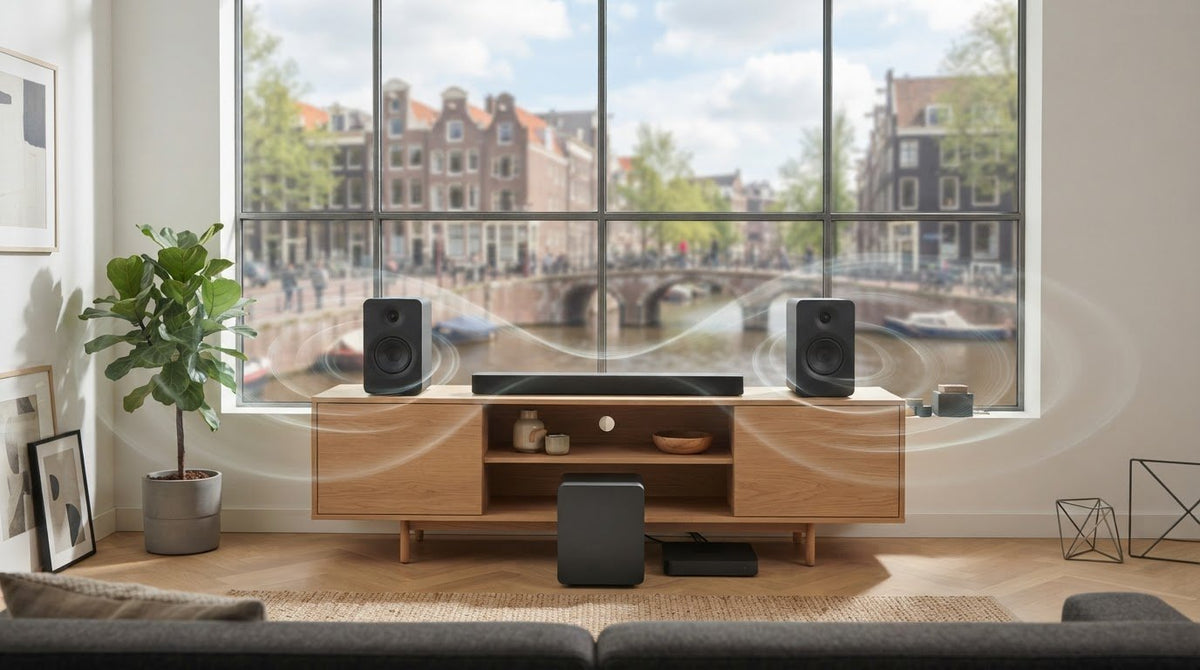
What if big sound doesn't require big speakers or a room full of separate equipment? You want to enjoy music and movies without your audiosetup dominating the room. Yet the choice is not always easy: do you go for a soundbar, compact speakers or an active solution? Making a compact audio solution deliver big sound starts with the right combination for your room and listening habits.
It's not just the size of the speakers that counts. Amplification, connections and placement also determine how full and immersive the sound sounds. A compact set that fits your space can be more pleasant than a larger setup that does not fit how you listen. Therefore, first consider what you play, which devices you want to connect and how much convenience you expect.
In this article you will discover how bookshelf speakers, active speakers and soundbars differ from each other and what role an amplifier, streamer or subwoofer can play. You can also read what to pay attention to when it comes to connections and placement. This way you can make a well-considered choice for a compact setup that suits you now and will continue to be a pleasant listening experience in the long term.
Key Points
- Discover how you can experience great sound with the right compact audio solution, without large equipment that dominates your space.
- Learn the difference between active speakers with built-in amplification and passive speakers that require a separate amplifier.
- Compare active speakers, bookshelf speakers with amplifier and sound bars on surface-mounting, ease of use and expansion options.
- Adjust your choice to your space and listening use: music, television, streaming or a combination thereof.
- Follow a practical decision route to choose a compact setup that suits your needs and method of operation.
How a compact audio solution works can sound big
You want to hear music full and compelling, but you prefer not to have large speakers or separate components dominate your living room. A compact audiosolution is a well-organized setup that allows you to play music, for example with active speakers or with bookshelf speakers and a separate amplifier. The goal is not simply to have as little equipment as possible. Choose a system that suits your space, listening habits, and control preferences.
A modest size doesn't necessarily mean a modest listening experience. How spacious or full music sounds depends on the rest of the system and the place where you listen. Your personal preference also counts: what sounds big to you does not necessarily have to be the same as what someone else is looking for. speakers, the rest of the system and the place where you listen. Your personal preference also counts: what sounds great to you does not necessarily have to be the same as what someone else is looking for.
What does big sound mean in a compact setup?
Big sound doesn't have to mean playing music loudly. Also pay attention to a full reproduction, intelligible details and a convincing stereo image, with instruments and voices clearly given their place in the music. A pleasant, balanced sound can be more pleasant than just a lot of volume.
The room plays along. The dimensions, design and placement of the speakers influence how you experience the sound. Therefore, consider not only the dimensions of an speaker, but also where it can be placed and from which place you usually listen. This way you discover which compact audio solution provides great sound in a way that suits you.
The core: great sound from a compact setup is created by the right combination of speaker, system structure and placement.
Which compact solutions do you come across?
Bookshelf speakers are separate speakers that you combine with a suitable amplifier. Check out the range of bookshelf speakers if you are considering a compact stereo setup. Active speakers have built-in amplification, so you need less separate equipment. An soundbar is another option, especially if you're looking for a compact solution for television and music.
With any system, sound is ultimately reproduced through speakers. Do you want to understand the basics? Read more about the operation of a speaker. Then choose the system structure that suits your use. A compact set for music in particular requires different considerations than a solution that focuses on television.
Do you want to keep equipment out of sight as much as possible? Then built-in speakers may be an option. For a closer comparison of bookshelf speakers and soundbars, you can also the differences between bookshelf speakers and a soundbar view.
How speakers, amplification and placement work together
A speaker converts an electrical signal into sound. The amplifier supplies the signal with which the speaker works. In a passive setup, the speaker and amplifier are separate parts; when speakers is active, the gain is in the speaker itself. Anyone who wants to know how speakers workwill see how parts such as the cone and voice coil contribute to that conversion. The practical lesson: match the amplification to the speakers and the intended use, and do not base your choice on one technical value.
A compact set only sounds like one whole when speakers, amplification and placement match each other. There is no one system structure that is best for everyone. Convenience, freedom of choice and the space in which you listen all play a role.
Active or passive speakers: what changes?
Active speakers combine the speaker and amplification in one design. As a result, you usually have fewer separate components and the setup remains clear. Choose this direction if you value simplicity and a limited number of devices.
Passive speakers connect to a suitable external amplifier. This requires an extra component, but gives you more freedom to choose speakers and gain separately. You can also replace or supplement parts later. Both routes can suit a compact audio solution with big sound, depending on your preference and wishes for the system.
Do you want to elaborate on the amplifier choice further? Then look at bookshelf speakers as a possible basis for a passive stereo system and consider which amplification suits this.
Why placement makes a difference
A carefully chosen set also benefits from a logical location. Do not automatically place speakers tightly against a wall or deep in a full cupboard. The distance from walls and other surfaces can affect how the sound sounds in the room. Where possible, follow the manufacturer's placement recommendations and try different positions.
Start with a symmetrical setup: place the left and right speakers at a similar distance from your listening position and point them toward where you usually sit. This way you give the stereo image a balanced starting position. Also pay attention to obstacles between the speakers and your listening position. A cabinet, screen, or other large object can affect the direct passage of sound.
Make small adjustments and listen from the same place every time. Move the speakers a bit, change their direction and compare the result. This way you discover which placement in your room suits your listening preference. After all, one fixed position does not work the same in every room.
Comparing compact audio setups: what suits you?
The best system structure depends on what you want to connect, how many separate devices you like and whether you mainly focus on music or television. An integrated solution keeps it simple. With separate components you have more freedom to choose parts and adjust the setup later. Therefore, compare the options based on use, not just on size.
| System structure | Required components | Ease of use | Possible extensions |
|---|---|---|---|
| Active speakers | Speakers with built-in amplification; possibly a source for music | Clear, with fewer separate devices | Depending on the connections and options of the chosen set |
| Passive bookshelf speakers | Speakers, a suitable amplifier and a music source | More components to coordinate with each other | Freedom of choice regarding components can be replaced or supplemented separately |
| Soundbar | Soundbar and a suitable connection to your television or music source | Compact, simple setup for image and sound | Depending on the capabilities of the soundbar |
The table helps you compare the options, but does not promise a fixed sound result. A compact audio solution great sound starts with a system that suits your use and space. Would you like to consider a stereo setup with two separate speakers ? View the bookshelf speakers and compare sizes and versions for your plans.
When to choose active speakers or a soundbar?
Choose active speakers if you want a compact stereo setup with less separate equipment. The amplification is built-in, so you don't need to install a separate amplifier. Do you mainly listen to music via streaming? Then consider in advance how you want to connect your music source. In the guide to a audio streamer you can read what to look out for.
An soundbar fits another priority: a clear solution in which television and sound are central. This can be nice if you do not want to set up separate stereo components around your TV. Decide what matters most to you: a two-channel setup for music or a compact setup around the screen.
When do bookshelf speakers with subwoofer?
fit? An subwoofer can be an addition if you want more emphasis on bass in music or film sound. Whether this is desirable depends on your listening preference, the room and the chosen speakers. First ask yourself whether you miss the bass in your current or planned setup. Then check out the subwoofers for extra bass reproduction as a possible expansion. Not every combination gives the same result.
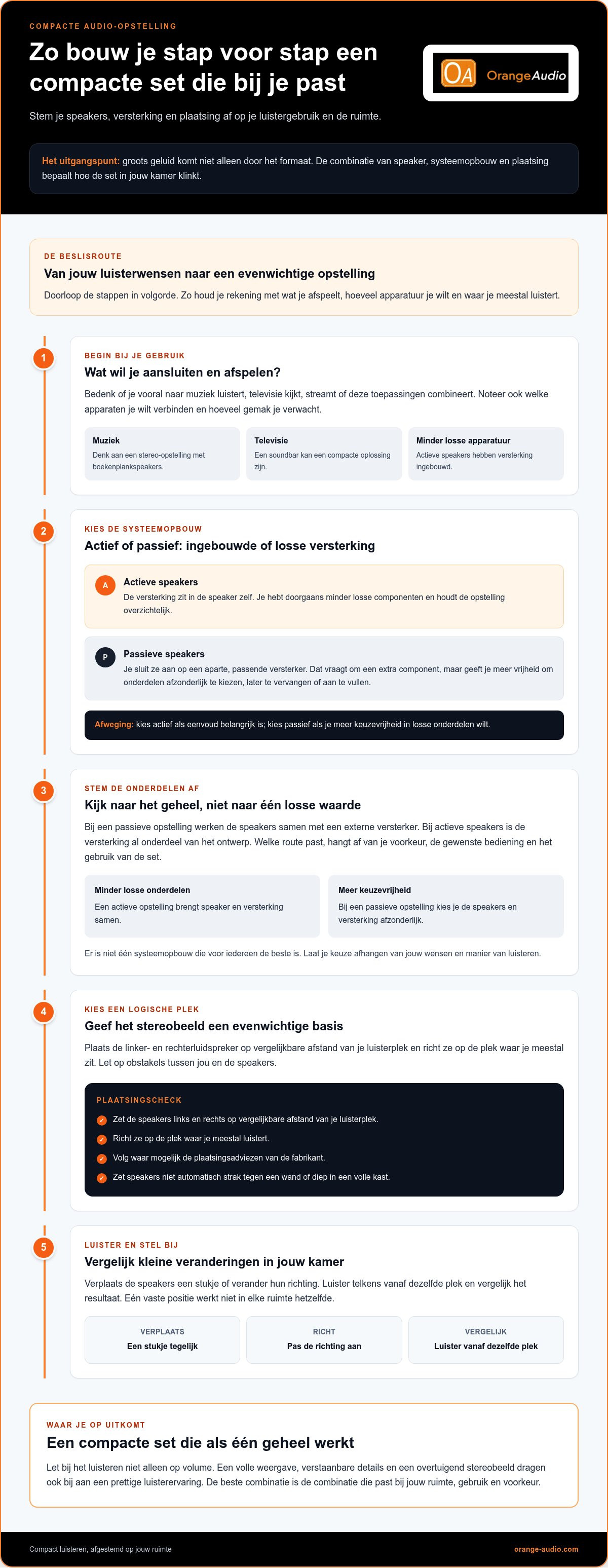
Choose your compact audio system step by step
A good choice does not start with a brand or technical term, but with your daily use. First map out the room, your listening habits and the desired operation. This makes it clear whether a compact stereo setup, a solution for television or a system for streaming is the best starting point. The right compact audio solution offers great sound, matches what you really use and fits practically in your home.
Start with your space and daily listening use
Note where you want to place the system and how you use that space. Do you usually only listen from one fixed location, do you often sit with roommates or is television the main focus? Also consider the available space for speakers, a possible amplifier and, if you want to add one, an subwoofer. This will prevent you from choosing a system that is difficult to fit in.
Walk past these points:
- Space: where can speakers be located without walking routes or furniture in the way?
- Use: do you mainly want to listen to music, watch television, stream or combine multiple functions?
- Listening position: do you listen from one fixed position or do you want to use sound while moving through the room?
- Arrangement: how much space is there for separate devices and cables?
Your answers guide the choice of system. For a simple setup, an integrated solution can be attractive. If you want to choose parts individually or adjust them later, a set with separate components may be a better fit.
Check the connection and controls
Before you choose components, make a list of your music sources and devices. Think of a television, record player, telephone or streaming services. Then compare the connections and operating options of the systems you are considering. View the product specifications per model: connections, controls and expansion options differ per model.
An integrated set can keep daily operations clear, while separate devices provide more choices. Decide what works best for you: one central control or separate components. If you want to listen wirelessly, compare the options with your own wishes and devices.
Also consider the location of the speakers in your choice. Check whether you can place them freely and in a logical listening position and whether the necessary cables and connections are accessible. This way you assess the entire system in context, not just the individual parts.
Discover a compact solution for your listening needs at OrangeAudio A suitable compact setup starts with four considerations: how much space you have, how you listen, what system structure you like and how you want to operate the equipment. Do you want to stream music easily? Or are you looking for a set that also fits the television and can grow with your wishes later? A compact
A suitable compact setup starts with four considerations: how much space you have, how you listen, what system structure you like and how you want to operate the equipment. Do you want to stream music easily? Or are you looking for a set that also fits the television and can grow with your wishes later? A compact one audio solution that provides great sound is not a universal combination, but a system that suits your daily use.
OrangeAudio has specialized in hi-fi since 2012. You will find bookshelf speakers, active speakers, soundbars, amplifiers, subwoofers and audio streamers. This way you can explore different routes: from an integrated solution with few separate devices to a setup in which you choose speakers and reinforcement separately. Roon Ready streamers are one of the product strengths.
From separate components to a coherent listening setup
Do you want to put together a compact stereo setup? Then take bookshelf speakers as a starting point and see which amplification suits them. An subwoofer can be an addition if you want extra emphasis on bass. The choice depends on your space and what you like to listen to. Coordinate components with each other and also think about connections and operation. speakers, your space and what you like to listen to. Coordinate components with each other and also think about connections and operation.
Active speakers fits if you want less separate equipment. With passive speakers and a separate amplifier, you choose the components separately. Neither form is best for everyone. The right combination matches your listening usage, available space and preference for simplicity or freedom of choice.
View the options and determine your next step
Compare systems based on more than their external dimensions. Look at the structure, connections, operation and the space you have at home. First decide whether music, television or streaming is your priority. Then think about the convenience you expect and about expansions that you may find important later.
View the bookshelf speakers if compact stereo speakers suit your plans. Discover which options suit your space and listening needs. Start with the experience you're looking for and then choose the system structure that suits it.
Make room for your ideal listening experience
A compact setup can sound convincing and immersive if speaker, system structure and placement match. Therefore, look beyond the size. First determine how you listen and what place you have at home. Then choose between active speakers for an integrated setup, bookshelf speakers with separate amplification or an soundbar if television and sound are central together.
Compare the options for connections, operation and expandability. So you won't just find a compact audio solution with great sound, but a system that suits your daily listening needs. A subwoofer can be an option if you are looking for extra emphasis on bass. The right choice depends on your space and preferences.
OrangeAudio has specialized in hi-fi since 2012. Discover the range of compact speakers, active speakers, soundbars, amplifiers and streamers, including Roon Ready streamers. Discover the compact audiosolutions from OrangeAudio and compare which system structure suits you. With a thoughtful choice, you can enjoy music and movies in a way that feels comfortable in your space.
Frequently asked questions
Can compact speakers sound big?
Yes, compact speakers can provide a full, spacious listening experience if the speakers, reinforcement and placement match well. Format alone does not determine how music sounds. The acoustics of your room, the distance between the speakers and your listening position also play a role. A compact audio solution can provide big sound without bulky equipment. Tailor your choice to your space and listening preference.
Which is better for a compact audiosolution: active speakers or an amplifier?
Neither is better for everyone. Active speakers have built-in amplification and are therefore an integrated choice with less separate equipment. Passive speakers connect to a separate, suitable amplifier. This requires an extra component, but gives you more freedom to choose the parts individually. Decide what matters more to you: a clear arrangement or more freedom of choice when putting together.
Is an soundbar suitable for listening to music?
Yes, an soundbar can play music and is a compact option if you like to bring image and sound together around the television. Whether that setup suits your music needs depends on how you listen and what functions you are looking for. If you mainly want to listen to music in stereo, also compare active speakers or bookshelf speakers. For each system, look at the connections and controls that suit your sources.
Do I need a speakers ? subwoofer for a compact
No, an subwoofer is not required as standard. Consider one if you want more bass emphasis in music or movies. The need depends on your listening preference, the room and the speakers you choose. Start listening to the setup without it subwoofer. If you then miss the layer display, you can view an subwoofer as a supplement. Also pay attention to the available space in the room.
How do you place the compact speakers for a good stereo image?
Place the speakers if possible symmetrically relative to your regular listening position, with a comparable distance to where you are sitting. Aim them at that spot and keep the space in front of them as clear as possible. Do not automatically place them tightly against a wall or deep in a full cupboard, because the placement can affect how you experience the sound. Change the position step by step and listen from the same place every time.
What does a compact audiosolution cost?
The costs depend on the system structure and the selected components. A set of active speakers requires a different composition than passive bookshelf speakers with a separate amplifier. A streamer or subwoofer can also be part of your choice. There is therefore no fixed amount that applies to every compact setup. First determine which functions you need and then compare the systems and components that suit them.