
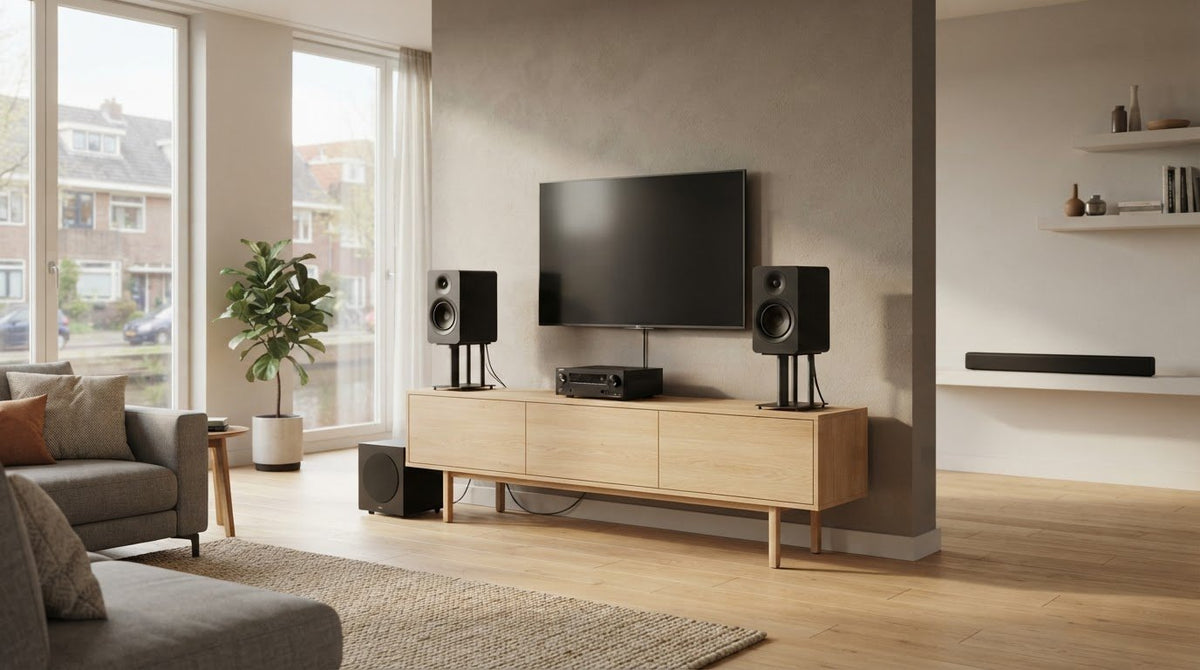
What if the biggest improvement does not come from more speakers , but from two speakers that really separate the sound left and right? When you upgrade from soundbar to 2.1 stereo, you can experience films, series and music differently, with a clearer stereo image and a separate subwoofer for extra bass. How much difference you notice depends on your room, your listening needs and the chosen set.
You may wonder whether separate speakers suit your living room. Or how to connect them to your TV, what amplification you need and where the subwoofer can be located. Make those choices clear: start with what you watch and listen to most often. Then check which audiooutputs your TV has and which inputs are available on the amplifier or active speakers.
In this article you will discover what a 2.1 system adds compared to an soundbar and how to combine bookshelf speakers or floorstanding speakers with appropriate amplification and a subwoofer. You can also read where you pay attention to HDMI eARC or an optical connection, the placement of the speakers and the available space. This way you make a choice that suits your room and your expectations, with an eye for quality and long-lasting listening pleasure.
Key Points
- Discover what two main speakers and an subwoofer can add to films, series and music.
- Learn the difference between passive and active speakers, so you know which amplification suits your set.
- Check the TV connections before you choose an upgrade from soundbar to 2.1 stereo.
- Map your listening position, the available space and possible locations for the subwoofer in advance.
- Follow a practical step-by-step plan to choose components, can be connected and adjusted properly at home.
Why upgrade from an soundbar to 2.1 stereo?
Do you want to hear music fuller, be able to follow dialogues well or give films more space? Then a set with loose speakers is worth considering. When you upgrade from soundbar to 2.1 stereo, you replace one compact sound solution with two main speakers and a subwoofer. That does not automatically mean that every 2.1 set will suit you better. The right choice depends on what you listen to, how much space you have and how simple you want your setup to be.
A 2.1 stereo system uses a left and right speaker for the stereo image, with a subwoofer as a supplement for the bass. The main speakers together provide most of the playback. The subwoofer supplements the bass, but does not replace the speakers not.
What exactly does 2.1 stereo mean?
The two main speakers each have their own channel. If you hear a guitar on the left and a singing voice in the middle in a song, the separate channels help make those positions in the sound image recognizable. That principle is called stereophonic sound. The subwoofer adds low tones, for example the deep bass in music or the booming effect in a movie scene. Together the two main speakers and the subwoofer form a 2.1 setup.
When do you notice a difference with an soundbar?
With music, separate speakers can provide a clearer left-right image. How spacious that sounds also depends on the recording and the position of the speakers. With films and series, the main speakers contribute to the stereo image, while the subwoofer supports low effects. Dialogues come from the left and right channels. There is no separate center speaker, so the balance and arrangement are important for intelligibility.
A soundbar remains attractive if you are mainly looking for a compact, simple solution. You have fewer loose parts and usually do not need a separate speakers next to the TV. A 2.1 set requires more attention to placement and the connection between the parts, but also gives you more freedom in choosing speakers and reinforcement. The switch is therefore not about a universal ranking, but about what you like to hear and use on a daily basis.
Curious to see how individual speakers compare to a soundbar? Also check out the article about bookshelf speakers if you are considering a compact speaker setup. This way you will discover which solution suits your listening preference and the space in your living room.
How does a 2.1 stereo system work with your TV?
With a 2.1 set, the sound from your TV first goes to the amplification. This sends the left and right channels to the main speakers and passes on the low sound to the subwoofer. The connection between TV and amplification differs per device. Therefore, first check which audiooutputs your TV has and which inputs are available on the amplifier or active speakers.
A 2.1 system usually consists of two main speakers, an subwoofer and amplification. That amplification can be built into active speakers or come from a separate amplifier. Which combination suits you depends not only on the speakers, but also on the way in which you want to connect TV sound.
Which parts do you need for a 2.1 set?
With passive speakers you need a separate amplifier. It receives the TV sound and sends the amplified signal to the speakers. Active speakers have built-in amplification. You connect the sound source to it with a connection that matches the available connections. In both setups an subwoofer can complement the low sound. For example, choose compact bookshelf speakers as main speakers and adjust the amplification and subwoofer to your listening needs.
Which TV connection should you check?
View the connections on your TV before choosing components. Possible outputs are HDMI eARC, an optical digital output or an analogue audiooutput. The correct connection depends on what your TV outputs and which connection accepts the amplification. HDMI eARC can return TV sound to a suitable device. You can connect the TV optically to an amplifier with a suitable input. Don't just rely on the shape of the plug: also check the connection names in the manuals.
For HDMI eARC, both the TV and the amplification must support this connection. If you use an optical or analog connection, this must also be available on both sides. Also think about the controls: see what settings the TV offers for sound output and adjust the chosen connection accordingly. The Dolby installation guide provides additional explanations about setup and home theater sound.
Do you want more insight into the function of amplification and its role in your set? Then also read a guide to hi-fi amplifiers. This is how you prepare the upgrade from soundbar to 2.1 stereo with a clear picture of the necessary parts and connections.
Soundbar or 2.1 stereo: which choice suits your living room?
The best choice depends not only on the sound, but also on how you use your living room. Do you mainly watch series and do you want as little equipment as possible? Then a soundbar can be practical. Do you also listen to a lot of music and do you want to tune speakers and subwoofer to your room? Then a 2.1 set gives you more freedom. Neither solution is automatically the best for everyone.
| Aspect of choice | Soundbar | 2.1 stereo |
|---|---|---|
| Stereo image | Sound comes from one compact housing. | Left and right speakers are separate each other. |
| Bass response | Depending on the soundbar and any subwoofer. | A separate subwoofer supplements the bass. |
| Space | Few loose parts around the TV. | Space needed for two speakers and one subwoofer. |
| Operation | Often one coherent solution. | Depends on the chosen speakers and reinforcement. |
| Freedom of choice | The composition is largely fixed. | You choose speakers and subwoofer separately. |
When is a soundbar the practical choice?
Choose a soundbar if a compact setup and easy operation are your priority. You have less separate equipment and usually fewer parts to coordinate. This fits well if you mainly want to improve the sound of the TV and have little space next to the screen. The listening experience varies per model and room, so compact does not automatically mean better or worse.
When does 2.1 stereo suit your needs better?
A 2.1 set suits you if you want to listen to music and TV sound via the same stereo set. You can choose the main speakers and subwoofer with your listening position and available space in mind. Individual parts require careful connection and placement, but do not have to be complicated. For example, an active set may combine gain in the speakers . If you want to delve deeper into connecting a stereo system to the TV, view this explanation about connecting stereo to a TV.
With an upgrade from soundbar to 2.1 stereo , first determine what is important: simplicity, space or the freedom to put together your set. Also check out the bookshelf speakers for your living room if you are considering a compact stereo set. Discover the options and choose the setup that suits your listening needs at OrangeAudio.

How to prepare the switch to a 2.1 set step by step
Good preparation helps you choose components that suit your TV, room and listening habits. First map out the connections and available space. Also think about where you usually sit and where the subwoofer can practically be placed. This way you avoid choosing a set that is difficult to connect or inconvenient to place.
A successful switch starts with your listening use, the connections and the space. You can then place the set, listen to it and adjust it where necessary.
- Determine what you listen to. Note whether you mainly use the set for music, films, series or a combination. This way you know what you want to pay attention to when choosing and the first listening test.
- Check the connections. Check which audiooutput your TV has and which inputs are available on the amplifier or active speakers. Check that information in the manuals before choosing equipment.
- Choose the parts. Decide whether you want passive speakers with a separate amplifier or active speakers with built-in amplification. In addition, choose a subwoofer that suits the speakers, your room and the way you listen.
- Plan the placement. Measure the space for the speakers and subwoofer . Take into account the location of your TV, furniture, listening position and cables. Make sure you can listen clearly to both speakers from your usual seat.
- Listen and adjust. Test the set with music and movie scenes that you know well. Move the subwoofer or adjust the settings if the bass sounds too loud or does not fit nicely with the main speakers.
Choose speakers and subwoofer based on your room
Not only measure the available floor and wall space, but also look at the distance between your seating area and the speakers. A small room with limited space requires different considerations than a spacious living room. There is no fixed subwoofer position that works in every room. Start with a practical place and listen to how the bass there coincides with the main speakers. View the subwoofers in the range to explore different options.
Connect, place and listen critically
Plan the cable route in advance and check whether each connection suits the chosen equipment. Then put on a familiar music track and play a scene in which you know dialogue and low effects well. Always change one thing at a time, such as the position of the subwoofer or its level. This way you can hear better what the adjustment does. An upgrade from soundbar to 2.1 stereo remains clear if you build up quietly and tune the set to your room.
View the range and discover which speakers and subwoofers suit your listening position. Discover the possibilities at OrangeAudio.
Choose your 2.1 upgrade with expert help from OrangeAudio
A suitable 2.1 set does not start with one separate part, but with the combination of your listening needs, living room and TV. Do you mainly listen to music, watch a lot of films and series, or do you use the set for everything? Also think about how much space you have and how easy it should be to operate. Then check which audiooutput your TV has and which connection matches the amplification or active speakers you are considering.
OrangeAudio has specialized in hi-fi since 2012. Start with your listening goal and the available setup. Then choose two main speakers that match and determine whether an subwoofer suits your desire for extra bass. This way you can build a set that suits you based on your daily use, instead of choosing parts only on the basis of individual properties.
Which parts suit your listening needs?
If you mainly listen to music, pay attention to the main speakers and their placement. The distance between the speakers and your listening position plays a role in how the stereo image appears in your room. Bookshelf speakers can be a suitable starting point when you are looking for compact main speakers. If you want more emphasis on low tones with films, series or music, consider an subwoofer as an addition. The right combination depends on the speakers, the room and what you like to hear.
Do you want to view the parts together? Then learn more about how to put together a hi-fi system. That helps you think about the role of reinforcement, speakers and bass response as one whole. For example, take a look at the bookshelf speakers and compare them with what you need for your living room.
Discover the options for your living room
Take your time to compare options. Don't just look at the shape or individual specifications, but also at the connection to your TV, the space the set takes up and how you want to operate it on a daily basis. A well-considered choice can provide you with years of listening pleasure. An upgrade from soundbar to 2.1 stereo is all about a coherent set that suits your room and listening habits.
Discover the hi-fi solutions from OrangeAudio and see which options suit your needs. Discover the hi-fi solutions from OrangeAudio.
Create your listening needs into a suitable 2.1 set
A good upgrade from soundbar to 2.1 stereo starts with what you listen to and watch every day. Determine how much space you have, which connection your TV offers and how much simplicity you expect from the operation. Then choose a combination of two main speakers, appropriate amplification and possibly an subwoofer. The placement and adjustment help the parts sound as one whole.
A soundbar remains a practical choice if you are looking for a compact, simple solution. With a 2.1 set you get more freedom to tailor speakers and bass response to your room and listening preference. OrangeAudio has specialized in hi-fi since 2012. The range includes bookshelf speakers, subwoofers and amplifiers, so you can view specific combinations.
Take the time to compare connections, setup and listening purpose. This way you not only choose a set that fits today, but also equipment that you can enjoy for a long time. Discover the hi-fi solutions from OrangeAudio and find inspiration for your living room. A suitable set starts with your way of listening.
Frequently asked questions
Is a 2.1 stereo system better than a soundbar?
Not automatically. The best choice depends on your listening needs, living room and preference for simplicity. A soundbar is compact and requires little separate equipment. With a 2.1 set you can choose and place two speakers and one subwoofer separately. This can be nice if you want to listen to music and TV sound via the same set. So compare not only the devices, but also how you use them every day.
What do you need for a 2.1 stereo system with your TV?
You need two main speakers, a subwoofer and a way to send TV sound to the speakers . Passive speakers includes an amplifier; active speakers have built-in amplification. Check which audiooutput your TV has and whether it matches the input of the amplifier or speakers. The correct connection varies per device. This is how you carefully prepare an upgrade from soundbar to 2.1 stereo.
Can I combine my existing soundbar with two speakers and one subwoofer?
Usually, an soundbar is not intended to work together with separate stereo speakers as one 2.1 set. The soundbar has its own speakers en sound processing, so combining can lead to double sound or an illogical balance. Some soundbars do support a matching subwoofer, , but that is different from connecting separate main speakers. Check the manual of your soundbar. For a real 2.1 set, use a suitable amplifier or active speakers.
Do I need an amplifier for a 2.1 stereo system?
That depends on the type of main speakers. Passive speakers require a separate amplifier to drive the sound of your TV. Active speakers contain their own amplification and can function without a separate amplifier, provided that the TV or other source can be connected appropriately. The subwoofer is also connected to the set in an appropriate manner. Before you choose, check which connections allow the parts to work together.
Where do you place an subwoofer with a 2.1 set?
There is no fixed place that sounds the same in every living room. Start with a practical position near the main speakers, without obstructing the passage or furniture. Then listen to familiar music or a familiar movie scene from your usual seat. Move the subwoofer if necessary and compare the result. Pay attention to whether the low tones fit comfortably with the main speakers, instead of sounding loose or overpowering.
Is a 2.1 system suitable for films and series?
Yes, a 2.1 set can be suitable for films and series. The two main speakers reproduce the left and right channels, while the subwoofer supplements bass. Dialogues sound through the stereo speakers, not through a separate center speaker as in some larger systems. The final display depends, among other things, on the TV connection and the settings of the equipment. Choose this setup if stereo suits your viewing and listening habits.