

The corner isn't automatically the best spot for your subwoofer. As a starting point, start about a third or two-thirds of the way up a wall and use 80 Hz as the common starting value for the crossover. To avoid mistakes when installing an subwoofer , listen for even bass and match the settings to your main speakers.
You want the bass to sound full, but not overpowering or cutting out in places. You can achieve this not only by placing the subwoofer down: the distance from your speakers, the phase setting and the volume also determine how well everything comes together.
Discover how to find a suitable spot and what to pay attention to with the crossover, distance and phase. You'll also learn how to gently tune the bass on your main speakers so that the transition sounds natural and music and movies retain their depth.
Key Points
- Start with a spot about a third or two-thirds of the way from the wall and listen for even bass there.
- Use 80 Hz as a common starting point for the crossover and tune it to your main speakers.
- Compare the phase setting with a familiar piece of music and look for full, coherent bass.
- Take into account the distance between the subwoofer and your speakers: this affects how well the bass comes together.
- Adjust the volume so that the subwoofer supports the music without letting the bass dominate.
At what frequency should I do the 'Crossover' set?
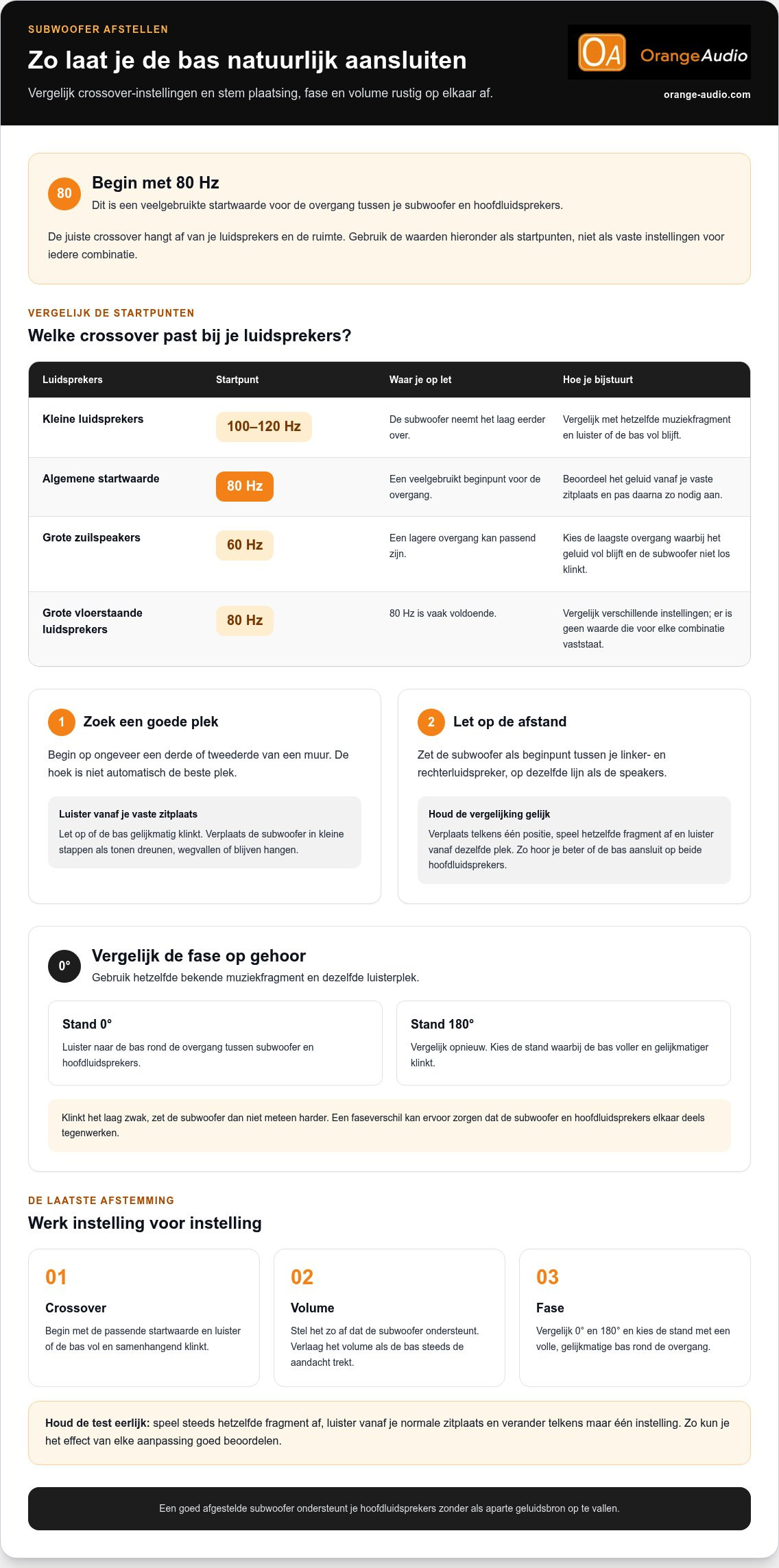
A crossover of 80 Hz is a common starting value for the transition between subwoofer and main speakers. Then adjust the crossover, volume and phase so that the sound sounds coherent.
Adjust crossover frequency to the room
The crossover frequency determines at what pitch the subwoofer takes over the bass from your main speakers. Start with 80 Hz and listen to a well-known music fragment with a clear bass line from your regular seat. If the bass sounds thick or booms for one note longer, try a lower setting. Small speakers may benefit from around 100 to 120 Hz; large column speakers can sometimes connect to 60 Hz. Choose the lowest transition where the sound remains full and the subwoofer does not sound disconnected from the music.
Include room characteristics in the adjustment
Room size, furniture and carpeting influence how the bass behaves in the listening room. In a compact room the bass can quickly sound emphatic, while furniture in front of a subwoofer muffles the sound. Floor coverings and furnishings also change the acoustics. Therefore, assess the settings at your normal listening position. Common connection mistakes include connecting the subwoofer to the wrong output or carelessly setting the crossover on both the receiver and on the subwoofer . If your amplifier does not have a dedicated subwoofer output, use the High-Level inputs on the speaker outputs.
Adjust the crossover after you have connected the speakers and subwoofer and chosen your listening position. With large floorstanding speakers, 80 Hz is often sufficient; for large column speakers, 60 Hz may be appropriate. Small speakers may require a transition around 100 to 120 Hz. Those examples are starting points, not fixed settings for every combination. Play the same music sample with each change so you can compare the bass fairly. Change one setting at a time and note which value gives the most natural result.
Then set the phase setting to 0° or 180° and compare both positions with the same clip. Choose the position where the bass sounds fuller and more even around the transition. Don't immediately turn up the subwoofer if the bass seems weak; a phase difference can cause the subwoofer and main speakers to partly counteract each other. A stepless phase adjustment can be more precise than a switch with only 0° and 180°. Take a short listening break in between and repeat the comparison from your usual seat.
Common mistakes when connecting are using the wrong input, forgetting the receiver setting or setting the volume of the subwoofer too high. First check whether the receiver recognizes the subwoofer ; Without a special subwoofer output, you can connect it via high-level inputs. LFE is the .1 channel of a 5.1 movie system, while the crossover determines how low and high the speakers distribute the sound. Therefore, do not let your receiver and subwoofer set the same transition twice without noticing.
Set the volume so that the subwoofer supports the main speakers and does not drown them out. Listen to music at a realistic level and lower the volume if the bass keeps grabbing your attention. Then, if necessary, change the crossover or phase, one setting at a time. This way you can avoid mistakes when placing an subwoofer and properly assess the effect of each adjustment. The right setting allows the bass to match the music, without making the subwoofer stand out as a separate sound source.
Distance between subwoofer and main speakers
The distance affects how the bass from your subwoofer and main speakers come together. Start with an uncluttered setup and listen from your regular seat.
Determining the distance to the main speakers
The distance between the subwoofer and your main speakers affects how evenly their sound converges at the listening position. Place the subwoofer first between the left and right speakers. This way, the bass remains close to the center of the stereo image and is less likely to come from one side.
If the main speakers are far apart, place the subwoofer not automatically next to one speaker. A place on the same line as the speakers is a good starting point. Play a piece of music with a clear bass line and move the subwoofer in small steps. Make sure that the bass notes match the sound from both main speakers properly.
The dimensions of your speakers also play a role. Smaller subwoofers and main speakers are usually closer together than larger models. In a compact arrangement, the subwoofer can therefore be close to the line of the speakers . For larger speakers, you can compare different positions as long as the bass doesn't seem to come clearly from one corner.
Change only one position at a time during testing. For example, note whether the subwoofer is on the left, middle or right of the set. Always listen from the same seat and use the same fragment. This way you can see whether a different distance allows the bass to connect better, without a different listening position or music choice influencing the comparison.
Avoid boomy bass and standing waves
A boomy bass sounds overly heavy. Standing waves can strengthen certain bass sounds and weaken others. Move the subwoofer out of a corner or away from an area where bass notes are stuck. Then compare the sound at your regular seat: a position can sound full in one part of the room and thin elsewhere.
Do not place the subwoofer tight against a piece of furniture or a wall. A piece of furniture can muffle the bass sound, while contact with a cupboard or floor can transmit unwanted vibrations. Place the cabinet on a stable, flat surface and ensure that it does not touch any furniture during playback.
Reduce contact noise by placing the subwoofer firmly and ensuring that it does not wobble. Also pay attention to loose objects on shelves or cupboards that may vibrate. If you hear rattling, move those objects or move the subwoofer further away from the furniture. This way you can distinguish cabinet vibrations from bass problems in the room.
A second subwoofer can distribute the bass more evenly across the room and help reduce areas of bass dropout. This requires a suitable setup: two devices in random places do not resolve standing waves by themselves. Start with one subwoofer and see how the sound changes as you move it. This way you can avoid mistakes when placing an subwoofer and better determine whether an additional source is needed.
Influence of distance and angle on phase
The position of your subwoofer changes the distance the sound travels to your listening position. This allows the bass to arrive at the same time as, or slightly differently than, the sound from your main speakers. That timing affects how strong the bass sounds together. A good starting position is about 30 cm from the wall, after which you refine the distance and angle while listening.
An angle can strengthen the bass, but also make it sound boomy or unclear. The walls amplify certain low tones, causing some notes to stand out. That effect is called a space mode. Move the subwoofer from the corner to a different position and always compare the same passage. A location about a third or a fifth away from the wall can help balance the bass.
The distance between subwoofer and the main speaker can also cause phase difference. A 40 Hz sound signal has a wavelength of 8.57 meters; at a distance of 4.27 meters, that signal can become out of phase with the main speaker. At 100 Hz the wavelength is 3.43 meters. A distance of 1.60 meters at that frequency can correspond to a phase difference of 180 degrees. The exact outcome depends on the listening position and the placement of both sources.
These examples show why a small shift sometimes makes an audible difference. When the bass from the subwoofer and main speakers counteract each other, the bass in your seat can be weakened. Therefore, move the subwoofer in small steps and always listen from the same place. Pay particular attention to a multi-note bassline. If one tone suddenly sounds thinner, compare it with the previous position before continuing.
The angle relative to the listener also plays a role, but low tones below 100 Hz are not sensitive to direction like high tones. So you don't have to point the subwoofer exactly at your ears. The distance to walls and speakers remains important, because reflections and transit time influence the interplay. Keep the enclosure free of furniture that could shield the sound.
Use a receiver's distance settings as an aid, not as a substitute for listening. For example, a receiver can delay a speaker at 1 meter compared to a speaker at 3 meters. Then check with music whether the transition at your seat sounds natural. The ideal position is not necessarily symmetrical: choose the spot where the bass remains even when listening between different bass sounds.
Main Speaker Tuning
A subwoofer is well-tuned when the bass sounds naturally match the main speakers. Judge the combination as a whole, not the subwoofer individually.
Start with a piece of music that you know well and in which the bass is clearly audible. Listen from your regular seat to the transition between the low tones and the rest of the music. The bass should support the main speakers, without you always hearing the subwoofer separately. Note changes in tone as the bass line changes notes.
Does the level of the subwoofer too high, then the bass quickly sounds disconnected from the music. Lower the volume until voices, melody and bass are in balance. Test with a fragment that contains both quiet passages and an emphatic bass line. If the subwoofer is especially noticeable during quiet parts, it may be too loud. Adjust the level for natural support, not maximum impact.
Then include the phase setting in your comparison. Play the same music clip and listen to the bass around the transition with the main speakers. Change the phase setting and see if the transition sounds fuller and smoother. If the subwoofer is at a different distance than the main speakers, the mutual phase may be different. With the phase setting you can assess and adjust the interplay.
Work step by step: keep the fragment and your seat the same, change one setting and listen again. For example, first adjust the volume, then the phase, then the crossover. This way you will notice which adjustment has an effect. A colleague can operate the settings while you continue to listen. This way you don't have to get up from your listening position every time and you don't confuse a changed listening position with a better adjustment.
Give your ears a rest in between. After repeated listening, a small change may become less obvious, so take a short break before comparing again. Also use music with different bass notes. A setting that makes one deep note sound impressive can overpower other notes. Proper tuning sounds consistent across multiple passages and allows the bass to support the music.
An analyzer with a measuring microphone can help to accurately assess the settings of an subwoofer . A measurement makes differences between frequencies visible, while listening shows what the combination sounds like in your room. Where possible, use both: measure as an aid and then check with familiar music. Take your time, because simply turning the knobs briefly provides little basis for careful adjustment.
Significance and effect of subwoofer phase
The phase setting determines how the movement of the subwoofer relates to that of your main speakers. If both move in the same direction at the same time, their low tones can reinforce each other. If they move in opposite directions, tones around the transition can actually weaken. You can hear this, for example, when a bass line sounds thinner as soon as the subwoofer plays along.
A simple phase switch often offers the positions 0° and 180°. At 180° the polarity reverses: the cone moves opposite to the movement at 0°. This can help when the subwoofer and main speakers are opposite each other. However, the correct setting depends on their position, the listening position and the transition frequency. So do not automatically choose 0° because the subwoofer is at the front.
Compare both positions with the same well-known music fragment. Choose a passage with a clear bass note and listen from your normal seat. Switch from 0° to 180° without changing the volume or crossover at the same time. If the bass sounds fuller and more even in one setting, then that setting is probably a better fit. Repeat the comparison with a second passage, so that one striking note does not determine your choice.
A stepless phase adjustment offers more options than a two-position switch. You can adjust the value gradually and listen where the bass meets best. This is especially useful when the subwoofer is not at the same distance as the main speakers. Only change the phase setting each time and keep your sitting position the same. This way you can hear the effect of each adjustment better.
Phase and distance are related, but not the same. Do you move the subwoofer, then the distance the sound travels changes. As a result, a previously appropriate setting may be less suitable. Therefore, readjust the phase after a significant change in position. With a receiver with room correction, distance settings can be taken into account. Then check with music how the bass sounds at your listening position.
When comparing, don't just pay attention to the amount of bass. A loud setting can seem impressive, but it can also hide loose or boomy tones. Look for a natural transition where bass notes remain clear and don't drop out. A measuring microphone can reveal differences between settings, while listening shows which setting suits your music best.
View the available subwoofers if you are looking for a model with adjustment options for careful tuning. Compare the controls and connection options with your current speakers and receiver. This way you choose a subwoofer that suits the way you want to adjust the phase and bass in your listening room.
OrangeAudio: Bookshelf Speakers
OrangeAudio offers Bookshelf Speakers for a listening setup in which you supplement the low tones with a subwoofer . Tailor the transition to the speakers and your room so that the bass supports the music without sounding disconnected. Would you like to compare a different speaker setup? Then also view the Floor-standing Speakers, Active speakers and Built-in speakers. When making your choice, take into account the available space and the role of your main speakers in the system.
Discover the Bookshelf Speakers and visit OrangeAudio to explore the possibilities.
Prepare your listening room for the next step
Do you want to avoid errors when placing a subwoofer , then take your own listening experience as a starting point when further developing your set. Consider how you use the space and which speaker setup suits it. This way you can continue to build a system that fits in with your music, films and interior.
OrangeAudio offers Bookshelf Speakers, Floor-standing Speakers and Active speakers. Which setup suits your room and listening needs? View the options and take your existing equipment into account. A suitable combination starts with clarifying what you want to hear and how you want to arrange the room.
Do you want to discuss ideas for the next step in your hi-fi setup? Contact OrangeAudio and find out which speaker setup suits your listening room. List your needs and start with a choice that will support your long-term listening pleasure.
Frequently asked questions
Where should I place my subwoofer ?
Find a suitable spot by first temporarily freeing up your listening seat. Place the subwoofer there and play music with an alternating bass line. Then listen from different places along the walls and compare where the bass sounds most even. This way you can find a suitable position without having to rely on one fixed location in advance. Move the subwoofer carefully and pay attention to notes that linger for a noticeably long time.
Can an subwoofer be placed in the cabinet?
A subwoofer behind or in a cabinet may sound less free, because furniture muffles the bass sound. A closed cabinet can also vibrate and add sounds that do not belong in the music. Listen to the same fragment with open and closed cabinet doors and compare the outcome with the subwoofer outside the cabinet. This way you can tell whether the cabinet is blocking the bass or causing unwanted resonance.
Can I use two subwoofers?
Yes, two subwoofers can be useful if the bass is lost in some seating areas. They can distribute bass more evenly throughout the room if you position and adjust them carefully. Two subwoofers are regularly used in home cinema; for music one is usually sufficient. Start by asking where you listen: one fixed place requires a different approach than multiple seats. Judge both setups from the places you actually use them.
More subwoofer advice?
Choose a subwoofer that matches your existing speakers and receiver. Pay attention to the connection options and the settings with which you can adjust the bass. OrangeAudio offers subwoofers for different listening setups. View the models and compare their capabilities with your current set. This way you can determine more specifically which properties are important for your listening room.
Should a subwoofer always stand in the corner?
No, a corner is not a fixed rule and not automatically the best position. The walls can amplify the bass, but this can cause the bass to sound boomy or unclear. Therefore, also try a spot along a wall, outside the corner. Play the same clip at each position and look for bass tones that sound overly emphatic. Choose the spot that sounds the most balanced in your room.
What if it doesn't sound right?
First change one part at a time so you can determine the cause. For example, check whether the receiver has recognized the subwoofer and whether the cable is connected to the correct output. If you hear a hum, a ground loop may be involved. In that case, connect the subwoofer and amplifier to the same socket. If the subwoofer turns off when listening softly, check the Auto-On function. Then compare the settings with familiar music.
Where do you put it?
Place the subwoofer in a stable place where the housing will not vibrate against a cupboard, sofa or other furniture. A place behind a sofa can be practical, but the furniture can also muffle the bass sound. Leave space around and listen from the seat where you usually play music. A small movement can already reveal whether a piece of furniture blocks the bass or vibrates along with it.
Where is the best place to place an subwoofer in the living room?
A suitable place in the living room depends on your seating position, the speakers and the furniture. Do not immediately place the subwoofer in the only available spot next to the television. Also test positions on another wall and listen from the couch. Pay attention to whether the bass remains pleasant when you move from chair to sofa. If the subwoofer is placed behind a piece of furniture, also listen to see if it noticeably dampens the bass.