
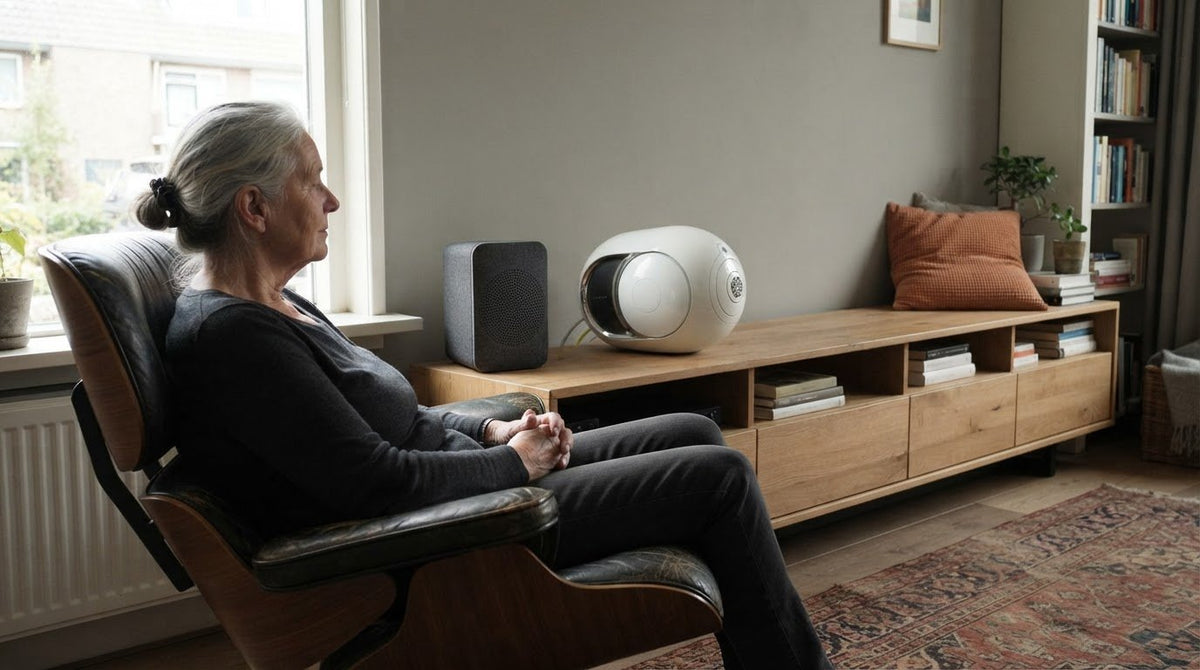
A cheaper alternative to Devialet Phantom does not have to offer the same in every area to suit your home well. The right choice depends on what you find important: full bass, a compact size, sufficient volume or wireless connections that match your equipment.
You are probably not only looking for a lower price, but also a speaker that suits your room and music taste. Therefore, don't just compare appearance. Pay attention to how the speaker sounds at the volume you usually listen to and whether the connections and wireless functions work with your existing equipment.
In this article you can read how to compare alternatives to the Devialet Phantom on bass response, size, sound pressure and wireless connections. You will also discover which properties are most important for your situation. This way you can determine more precisely what you may have to compromise on and what you need in your listening room.
Key points
- Adjust your choice to the room and listening distance; Size alone does not tell you how full a speaker sounds.
- Compare the bass response and the behavior at high volume, so you know which features count for your listening style.
- See which wireless connections suit your music sources and devices at home.
- Weigh sound pressure, housing and connection options together to make a suitable choice.
- Discover how bookshelf, floorstanding and active speakers to suit different home needs.
Frequency range and bass response
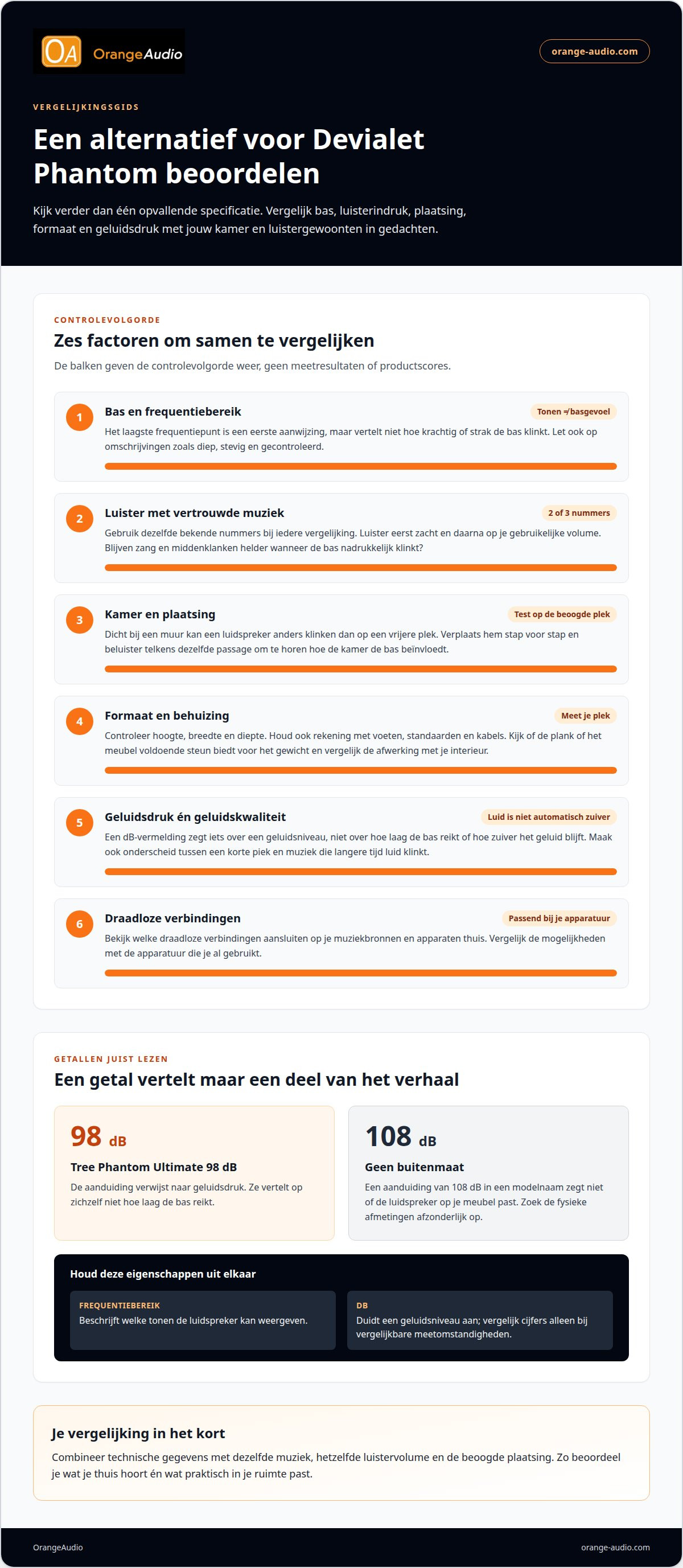
The frequency range indicates which low and high tones a speaker can reproduce. The lowest frequency provides an initial indication of the bass, but does not indicate how powerful or tight it sounds. A speaker can reproduce low tones and yet sound less full in your living room. The room, placement and volume also play a role.
Do not just compare the specifications of the Devialet Phantom and an alternative. Also pay attention to descriptions of the bass response, such as deep, firm, controlled or emphatic. Those words give an impression, but in themselves they are not a measurable comparison. View them together with the stated frequency range and listen to music you know well where possible.
For example, the name Tree Phantom Ultimate 98 dB contains a designation for sound pressure. That 98 dB in itself does not say how low the bass reaches. Keep those properties apart: frequency range describes tones, while dB indicates a level. This way you prevent one striking number from determining your choice for a cheaper alternative to Devialet Phantom .
Pay attention to what you actually hear when playing low tones. Deep bass can sound impressive in electronic music, while tight bass is important for a recognizable double bass or clear kick drum. Take two or three familiar songs with you and listen first softly, then at your usual volume. Do vocals and mids remain clear when the bass is emphasized?
- Look at the lowest frequency point, but don't treat it as a complete assessment.
- Compare bass words such as deep and controlled with your own listening impressions.
- Use the same numbers and same listening volume for each comparison.
Room also affects bass. Close to a wall, a speaker may sound different than in a more open location. Therefore, test the intended placement before assessing the bass. Move the speaker step by step and listen to the same passage each time. This way you will notice whether the room amplifies the bass or makes it sound less present.
If you want to view the properties of Devialetmodels side by side, discover the Devialetmodels. Use frequency response as a starting point, not a final decision. The best comparison combines technical data, placement and your listening experience. This allows you to judge bass reproduction on what you hear at home, not just on a specification.
Size and housing
A speaker should not only look nice, but also fit in the place you have for it. Measure the available height, width and depth before comparing models. Consider the edge of a shelf, space next to furniture and where cables exit. This way you prevent a model that looks appropriate from turning out to be too large in practice.
Check the dimensions of the entire housing. Due to a rounded shape, a speaker can take up more space than the widest size suggests. Also look at the base or stand, as it can increase the overall width. Write down the specified dimensions next to your own measurements and then compare which version fits your cupboard, dresser or floor.
Also take the weight and surface into account. A heavy speaker requires stable furniture, while a narrow shelf may not provide enough support. When placing on furniture, check whether the surface is sturdy and wide enough. For a floor-standing model, clear the entire space in advance, including space to walk past it.
The shape partly determines how easily you can incorporate a speaker into your interior. A compact model can fit on a bookshelf; a higher model is more likely to require free space on the floor. Also see how the finish matches your furniture and equipment. A quiet housing can blend in with the interior, while a striking design catches the eye.
- Measure height, width and depth of the intended location.
- Include protruding feet, stands and cables in the space planning.
- Check whether shelf or furniture provides sufficient support for the weight.
- Compare the finish with furniture and equipment in the same room.
The indication 108 dB in a model name does not describe the outside dimensions. So don't use it to determine whether a speaker fits your furniture. Look up the physical dimensions separately and measure the area yourself. This way you keep technical indications and practical dimensions apart.
Also think about the location for amplifiers. In a system with separate amplifiers, you must reserve space for this and keep the connections accessible. With active speakers, the amplification is in the speaker housing, allowing you to arrange the setup differently. Compare both options with the available space and your existing equipment before you choose.
Sound quality and maximum sound pressure
The maximum sound pressure indicates how loud a speaker can play, but not how pure the sound remains. A separate dB statement for the Devialet Phantom or an alternative therefore says little without information about the measuring conditions. Distance, frequency and the limit for distortion influence the outcome. Only compare figures if they were measured under similar conditions.
Distinguish between a peak and a long-lasting powerful sound. A short peak, such as a hard drum beat, requires something different from music that sounds loud for a longer period of time. In the specifications, note the Description of the maximum level and any information about distortion. A speaker that reaches a high level is not automatically the right choice for an open, relaxed sound.
Sound quality is more than volume. Pay attention to the balance between vocals, instruments and bass. A voice that sounds clear without being harsh makes long listening sessions more enjoyable. The separation between instruments also matters: in a busy arrangement, for example, you want to be able to follow guitar, vocals and drums separately. That gives a more complete picture than one maximum value.
Dynamics are also important. This describes how convincingly a loudspeaker reproduces differences between soft passages and powerful accents. In an orchestral piece, quiet strings should not disappear as soon as the brass section starts. In addition, pay attention to the attack and decay of notes: a piano note or drum beat should start clearly and not linger as a flat sound.
Manufacturer specifications help you make more targeted comparisons. Check whether information about maximum sound pressure, distortion and sensitivity is available. Sensitivity indicates how efficiently a speaker converts an electrical signal into sound. Evaluate the value together with the gain and the intended listening distance. Without equivalent metrics, you can't reliably rank models on a single number.
- Assess maximum sound pressure in addition to distortion and measurement conditions.
- Compare voice clarity and instrument separation.
- Pay attention to dynamics, from soft passages to short musical accents.
- Take gain and listening distance into account when reading sensitivity.
This gives you a more balanced picture of a speaker than with just a dB indication. Choose features that suit your music and listening space. For vocals, a clear midrange can be more important than an impressive peak level. With a large, dynamic piece of music, reserve and controlled playback can be more important. Therefore, view the specifications as a whole.
Bass response and high volume performance
At high volumes, deep bass demands a lot from a speaker. The cone moves further to reproduce low tones with sufficient level, which requires room to move and power. As the limits of the system get closer, the bass may sound less solid. A large bass peak does not necessarily sound deeper or more convincing.
Therefore, pay attention to the difference between bass that sounds loud and bass that remains controlled. A kick drum must maintain its short attack; a long bass note should not turn into a sustained boom. That depends on the speaker, the amplification and the space. A room can amplify low tones in some places, causing a bassline to sound heavier from one seat than from another.
The type of music also determines how heavily the speaker is loaded. An electronic production with long bass sounds requires something different than a recording with short bass turns. Think about how you usually listen: do you often hear heavy low tones or does the bass mainly occur in loose accents? This helps you estimate how much reserve your system needs during intensive passages.
With a separate subwoofer you can have the lowest tones reproduced by the subwoofer . The main speakers then do not have to reproduce all low tones only at a high level. The result depends on the coordination between the parts. A transition that does not fit properly can cause a hole or a build-up in the bass. Therefore, take a look at the setting options and the connection between subwoofer and speakers.
- Determine whether your music mainly contains prolonged deep bass tones or short accents.
- Note whether a speaker has sufficient reserve for your usual listening strength.
- Consider a subwoofer when deep bass is an important part of your music is.
- Assess the connection and tuning of the subwoofer with the main speakers.
More bass is not always better. An exaggerated emphasis can make rhythm and melody less likely to coincide. At high volume you want the bass to support the whole without overpowering other parts. For example, the notes of a bass guitar should keep their own character and not merge into one low sound.
Choose based on your listening habits and the role that bass plays in it. If you often play powerful electronic music, sufficient reserve and appropriate bass reproduction are important. For music with less pronounced bass, a balanced reproduction can be given priority. This way you choose features that you actually use, instead of just looking at maximum power.
Wireless connectivity
There is no fixed feature list that applies to all cheaper speakers. Compare the support for streaming services, control via an app, multi-room and connections per model. This way you can see which functions you need and which you probably don't use much.
Start with your music sources. Do you mainly listen via a telephone, television or streaming service? Then check which wireless connections the speaker supports and whether they work with your devices. Bluetooth can be useful for playing directly from a phone. Network streaming can match listening via your home network. Check the specs of the specific model before assuming a particular feature.
A Devialet Phantom and a cheaper model may offer similar connections on paper, but ease of use differs. For example, see if you can start music directly from the app you want. Also check whether the speaker works well with the controls on your phone. A connection that you use every day is often more relevant than a long list of functions.
If you want to listen in multiple rooms, pay attention to multi-room. This function allows suitable speakers to play music simultaneously or per room. Check whether the models work together within the same system. A speaker with its own app may work differently than equipment that you operate via an existing music app. Choose based on the devices you already use.
- Note your main music source, such as phone, television or streaming service.
- Compare Bluetooth, network streaming and app control by model.
- Check whether multi-room fits your existing speakers.
- See if an analogue input is required for a wired source.
An analogue connection is also possible. important, for example for a record player or other wired source. Wireless capabilities do not automatically replace such connections. Therefore, take a look at both the connections and the wireless functions. This prevents a speaker from being suitable for streaming, but not for your existing equipment.
Compare functions in the order in which you use them. Start with the music source, then check the controls and then look for expansion options. A long feature list does not automatically make a model more suitable. If you only listen from one phone, simple operation may be more important than multi-room. If you want to add other rooms later, take that option into account immediately in your choice.
Compare the wireless speakers and connections with your listening habits. This way you not only assess which connections are present, but also whether you can practically use them at home. Choose functions that you really need and only consider extra options if they fit your plans.
OrangeAudio: Devialet
OrangeAudio helps you translate the differences into a suitable choice for your home. Compare Devialet with Bookshelf Speakers, Floor Standing Speakers and Active Speakers. This way you can see which size and type of system suits your room and listening habits.
Are you mainly looking for a compact speaker, a free-standing setup or a model with amplification in the housing? Start with those preferences and then compare bass response, volume and wireless connections. This makes it clear which features are most important to you.
Feel free to contact OrangeAudio to discuss your choice and wishes for your home.
Prepare your choice for your home
Choosing a cheaper alternative to Devialet Phantom choosing starts with how you listen to music at home. Don't just consider the speaker, but also the location, your music sources and the role the device will play in your interior. This way you make a practical choice that goes further than a comparison on paper.
OrangeAudio offers Bookshelf Speakers, Floor-standing Speakers en Active speakers. With these types you can tailor the setup to your room and wishes. Determine which type suits your use and then compare the models that match your listening position and equipment.
Include your most important wishes in a conversation: where the speaker will be placed, which music sources you use and how you like to listen. OrangeAudio can help you explore the possibilities within the range. Discuss your wishes with OrangeAudio and take the next step towards a sound setup that suits your home.