

Music can influence your mood, attention and movement. The emotional impact of music with high-end audio comes from the combination of what you hear and how convincing the sound is reproduced. A refined reproduction can make subtle details, dynamics and spaciousness more audible. The emotions you experience remain personal.
A familiar song can evoke memories and a rhythm can give you energy. The sound quality also plays a role in how intense and compelling music sounds. High-end audio is interesting because a carefully composed system can reproduce music coherently and nuanced, not because equipment evokes the same feeling for everyone.
Discover how music can influence your behavior and mood, what happens in your body and brain and what role digital sound quality plays in this. We also look at how the speakers, amplifier, music source and listening room together shape the experience. This gives you a clear picture of what high-end audio can add to your listening moment.
Key points
- Discover how music can influence your mood, attention and tendency to move, without assuming that one musical style has the same effect on everyone.
- Learn why peace, control and dynamics in the reproduction contribute to how your music experience.
- See how digital sound quality, your listening room and the connection between audio equipment shape the experience.
- Read which physical and psychological reactions music can evoke and why your personal preference matters.
- Discover what you can pay attention to when choosing Bookshelf Speakers for a more involved listening experience home.
Does music influence our behavior?
Yes, music can influence your mood, attention and behavior. For example, stores sometimes tailor music to their image, hoping that customers will be more likely to buy something.
Quiet, control and dynamics
Quiet, control and dynamics describe how clear, coherent and lively music sounds. They determine whether you can follow individual instruments or hear a busy whole.
A suitable combination of amplifier and speakers contributes to balance and control. For example, a quiet recording at low volume can remain subtle, while a sudden drum beat sounds powerful. High-end systems, according to the described characteristics, aim for more control, less distortion and a greater dynamic range. This helps bring music to life without making each clip sound equally loud or emphatic.
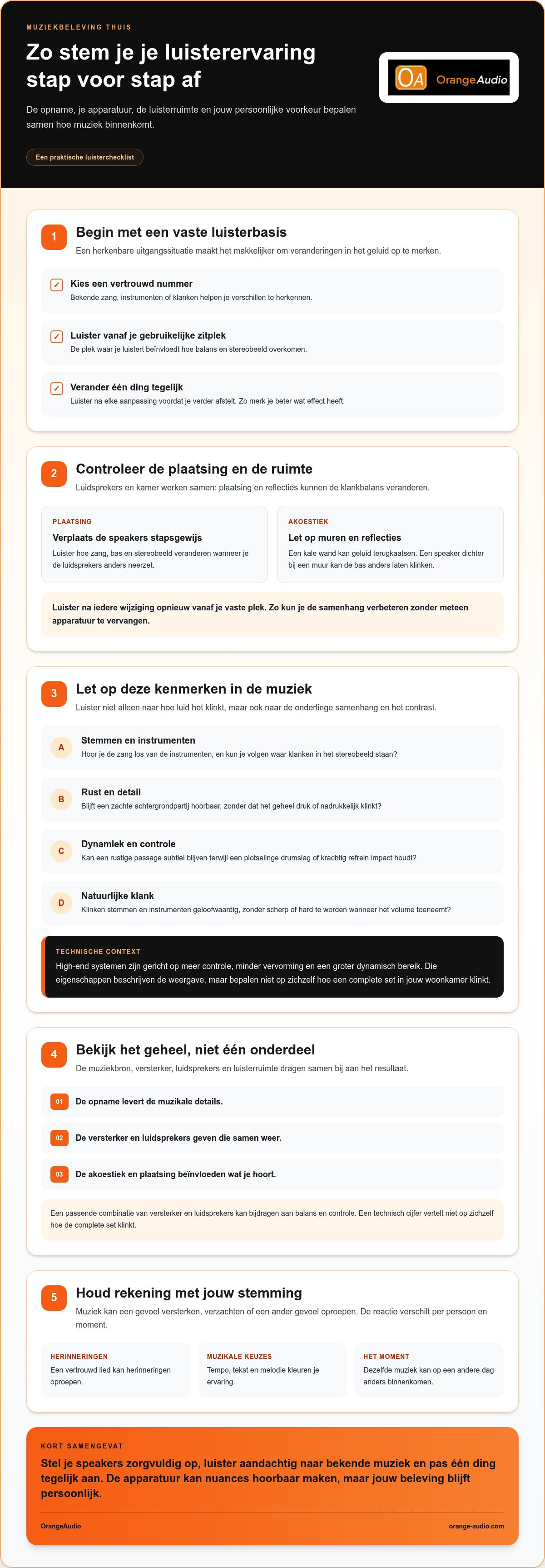
A simple first step is to adjust the speaker placement and readjust the set. Move the speakers step by step and listen to how vocals, bass and stereo image change. This way you discover what works without immediately buying new equipment.
Credible reproduction and distortion
Believable reproduction makes instruments and voices sound natural, while distortion changes the original sound. Think of a piano note: it should not sound sharp or loud when the volume increases.
In the ultra-high-end segment, the distortion of amplifiers is often one thousandth, according to the introduction. The same introduction mentions a distortion of 0.1% for amplifiers. Such figures describe a technical aspect, but do not in themselves tell you what a complete set sounds like in your living room. The speakers, the amplifier and the acoustics also together determine the result.
A quiet reproduction does not mean that music sounds tame. It's about control: a soft background part remains audible, while a powerful chorus retains its contrast. This allows you to listen to a recording in a relaxed manner, even at a lower volume.
Music experience and live sound
By live sound we mean the spatial and dynamic impression of a performance, not that the recording is actually live. That impression can help you experience music as a coherent event.
An interviewee describes how a studio recording can feel like a stage 30 meters wide and 4 meters deep, even in a listening room of 4 by 3 meters. That example shows how width and depth in a sound image can appeal to the imagination. There is no guarantee that every recording or set will produce the same effect.
While listening, compare a recording with clearly placed voices and instruments with a compact mix. Pay attention to where the vocals sound, how the instruments are distributed between them, and whether loud passages retain their impact. This way you discover which presentation captivates you.
Influence of speakers, headphones and acoustics
Speakers, headphones and acoustics determine how sound reaches your ears and how you experience music. Headphones bring details directly around your ears, while speakers also make the room resonate.
In a living room, placement and reflections influence the balance and the stereo image. For example, a bare wall can reflect sound, while a speaker closer to a wall makes the bass sound different. Move the speakers and listen from your usual seat. Always change one thing at a time, so that you notice which adjustment makes a difference.
Adjust your system at home step by step. Place the speakers carefully, assess the sound from your regular listening position and compare the balance to a familiar song. Listen after each change before adjusting further. This way you can improve coherence without immediately purchasing a new part.
The emotional impact of music with high-end audio does not only depend on the equipment. The recording, playback and space also play a role. Together they determine whether music remains in the background or draws your attention completely.
Music and mood
Music can enhance a mood, soften it or evoke a different feeling. Research shows that the vast majority of listeners say music strongly influences their mood. During challenging times, many find that music helps them get through a difficult time. These figures show how music takes on meaning for many people, but your reaction also depends on memories, preferences and the moment you listen.
A familiar song can bring back a memory, while a quiet piano piece can support a calm atmosphere. The same music can arrive differently on a different day. A song can make you happy during a car ride, but can make you feel melancholy at home. Your mood is not only affected by pace and volume. Text, melody and personal associations also color your experience.
The natural timbre of a voice or instrument helps you recognize nuances. A warm cello sounds different from a bright violin. A human voice has breathing, articulation and minor tonal variations. For example, listen to a recording with vocals and piano. Do you hear the voice separate from the keys, or do the two flow together? Such details can make music seem more human or more distant.
The equipment also influences how timbres reach you. Thanks to high-quality components made of OrangeAudio , subtle nuances are optimally reproduced. The music source supplies a signal, which is converted into sound via amplification and speakers. If a recording retains details, you can, for example, better follow soft vocals or the touch of a guitar. This does not mean that technology determines your mood, but the musical expression can become clearer through high-end audio emerge more clearly.
Consciously compare your listening experience. Choose a song you know well and listen first at low volume, then a little louder. Pay attention to the voice, the bassline and the rhythm. Which element catches your attention, and what feeling does it evoke? This way you will notice whether a quiet performance helps you relax or whether a firm rhythm makes you more active.
The amount of time that music takes up in daily life makes this interaction recognizable. Enthusiasts spend hundreds of hours each year listening to favorite albums and playlists. This could be while cooking, as a moment of rest at the end of the day or while traveling. Therefore, don't just choose based on genre. Also pay attention to the atmosphere, the natural sound of voices and instruments, and how the emotional impact of music with high-end audio optimally matches your listening moment.
Emotional impact and experience of digital music
Streaming, CD and vinyl can each provide an intense music experience. Sound quality depends not only on the format, but also on the recording, mastering and equipment. A CD does not automatically sound more natural than a stream, and vinyl does not evoke the same emotion in everyone. The personal value of an album can be just as decisive as the technology.
With streaming you can quickly choose a song, album or playlist. This makes it easy to find music for a moment, such as quiet piano sounds while reading. The final appearance depends partly on the version and settings you use to stream. Therefore, compare the same song and pay attention to vocals, instruments and dynamics, not just the name of the service.
A CD offers a tangible carrier and a fixed album order. You play the disc and hear the songs as they appear on that release. Vinyl requires a more conscious listening moment: you take the record out of the sleeve, put it on the turntable and choose a side. That ritual can bring back memories or keep your attention on the album. In itself it says nothing about the technical quality of the recording.
Compare formats by choosing one album that is available in multiple ways. Listen to the same song through the same speakers or headphones and keep the volume as even as possible. Pay attention to how intelligible the voice is, how much space there is between instruments and how soft and powerful passages flow into each other. This way you judge what you actually hear, instead of just the format or reputation of Brands.
The emotional layer is often in recognition. 88% of people surveyed in Europe said that music played an important role in their memories. A song that connects you to a certain period can therefore feel different from an unknown recording, even if both run through the same system. A familiar melody can evoke a memory; a new recording may actually catch your attention because of an unexpected instrument part.
Specifications help you compare parts, but they don't fully tell you what a system sounds or feels like. Therefore, listen carefully to your own music, for example a voice recording, an acoustic song and a track with strong bass. Find out which version you like and which details touch you. The best choice is not automatically the latest format, but the combination of recording, equipment and listening habits that appeals to you most.
Physical and psychological effects
Music reaches more than your ears: your brain processes sounds and can respond to them physically. A quiet piano piece, a strong drum rhythm and singing together can each evoke a different experience. The effect varies per person. Rhythm, melody and memories help explain why music sometimes hits you immediately.
Research from McGill University on music and the brain describes that emotional highs can evoke feelings of euphoria. While listening, the brain converts acoustic energy into neurological signals. This can activate neurotransmitters such as dopamine, which are involved in pleasure and reward. A recognizable melody that refers to a special moment can therefore feel extra intense.
Movement also plays a role. Music activates brain areas involved in emotions and movement. An exciting rhythm can encourage you to tap along, dance or step more briskly while walking. A calm, stable rhythm can actually have a calming effect and lower the heart rate. These are possible responses, not a fixed outcome for every listener or every piece of music.
During a work task, music can support your attention by helping to limit distractions and promote a productive flow. For example, choose instrumental music if lyrics demand your attention. A serene soundscape can help you wind down for the night. Pay attention to your own reaction: turn the music down or choose something else if your concentration decreases.
The experience does not only depend on the type of music. Speakers and amplifiers reproduce the sound, while rhythm, recording and listening room together determine how you experience music. A quiet song at low volume can already create a relaxed atmosphere; an energetic track can actually invite you to move. The technology supports the reproduction, but does not automatically make your emotional response stronger.
Making music together adds a social dimension. Singing together stimulates the production of oxytocin and can strengthen the feeling of connection. Singing with someone who speaks little can also be meaningful: singing can help people with dementia when talking is difficult or impossible. Music can therefore support communication and togetherness, even when words fail.
80% of people surveyed said they want to listen to more music because it is good for their physical and mental well-being. Put that thought into practice: choose a song for relaxation, a rhythmic playlist for movement, or gentle music for your evening routine. Researchers from the University Medical Center Groningen are investigating how live music influences the pain experience of patients in the surgery department. That research focuses on a specific healthcare situation; it does not prove that music reduces pain for everyone.
Does high-end audio demonstrably improve the emotional music experience?
High-end audio can provide audible differences in sound reproduction, but does not automatically prove that your music feels stronger. Technical properties describe, for example, distortion, dynamics and balance. Your emotional response also depends on the recording, your preferences and the situation in which you are listening. A measurable difference in sound is therefore not the same as a measurable difference in feeling.
Assess the listening experience based on two questions. What audibly changes in the display? And what change affects your experience? Take a recording with soft vocals and a powerful instrumental passage. A system with more control can make the contrast more apparent. You can only discover whether that makes the music more moving by listening yourself.
Specifications are useful for comparing equipment, but do not fully predict what a complete set sounds like. The connection between speakers, amplifier and music source counts. The listening room and adjustment also influence the result. A carefully matched set in a lower price segment can sound more convincing than expensive components that work less well together.
Therefore, do not just compare Brands or individual figures. For a fair listening test, use the same recording, same system and comparable volume. Choose music you know well, such as a song with clear vocals, a quiet passage and a sudden transition. Then make a specific note of what you hear: does the voice remain intelligible, do instruments retain their character and do dynamics sound natural?
Distinguish between preference and accuracy. You may prefer a warm sound, while another listener may prefer a more direct sound. Neither response proves that one system objectively conveys more emotion. The emotional impact of music with high-end audio arises in the meeting between the recording, the playback and your own associations.
A meaningful improvement does not necessarily start with a more expensive part. First, look at the entire set and the conditions in which you are listening. A small adjustment in placement, timing or balance can change the presentation. Judge the result with the same music fragment. This way you will discover whether the technical gain also has meaning for you.
The conclusion is nuanced: high-end audio can make differences in control, distortion and dynamics audible. These properties can enhance details and contrasts, but do not guarantee a stronger emotion. Listen carefully, compare music you know and decide which playback really moves you.
OrangeAudio: Bookshelf Speakers
OrangeAudio helps you choose a speaker that suits your listening space and music preference. Bookshelf Speakers are a possible start if you are looking for a compact setup. Compare them with Floorstanding Speakers, Active speakers or Built-in speakers. Also consider how you usually listen: attentively from your favorite chair or as a background during everyday moments.
When choosing, pay attention to the relationship between speakers, amplifier and room. A suitable combination can contribute to a balanced reproduction, but your ears determine which sound feels pleasant. Discover the range and compare the options calmly, so that you choose a system that suits your way of listening.
Do you want to discuss your options? Contact OrangeAudio or visit orange-audio.com.
Choose a listening experience that suits you
Make your next listening moment a journey of discovery. Choose an album that you know well and listen to it at a different time of the day. You may hear different accents during a quiet evening than when you put on music while cooking. This way you discover what attracts your attention and which listening environment feels pleasant.
The emotional impact of music with high-end audio is personal. Therefore, give yourself the space to develop preferences, instead of just chasing technical features. Think about how you listen to music at home and what experience you want to create more often. This way you can make any choice for audio equipment more consciously and better tailored to your daily life.
View the options at your leisure and be inspired by different ways to experience music at home. Discover the audiosolutions from OrangeAudio and take the next step when the moment feels right for you.
Frequently asked questions
How does listening to music influence emotions and mood?
You can consciously make music part of your daily schedule. For example, create a playlist for a recurring activity, such as reading or tidying up, and see if it helped you complete the task. Be mindful of song lyrics: Words can demand your attention when you read or write. Try different types of music and discover what suits your routine.
What is high-end audio and what makes it different from regular audio?
High-end audio is a designation for high-quality sound equipment, not a fixed technical standard or one specific type of set. Therefore, determine what you need: do you mainly listen to digital music, do you also want to connect a record player or are you looking for a setup for multiple rooms? Make a list of your sources and daily use in advance. This way you choose equipment that meets your needs, instead of just based on a label.
What role do sound quality, dynamics and detail play in the emotional impact of music?
A practical listening test helps you assess which properties are important to you. Choose a recording with clear vocals and listen to see if you can comfortably follow the lyrics. Also pay attention to whether you continue to listen comfortably after an entire album, instead of just paying attention to one impressive fragment. Compare at about the same volume: a louder sound may seem more appealing, even if the sound itself doesn't better suit your preference.
Which scientific studies measure the emotional effects of listening to music?
Researchers can study responses to music in different ways. For example, in listening tests they ask participants to rate their feelings after a fragment. Other methods record physical signals, such as heart rate or skin conductance, while listening. These results answer different questions: a questionnaire describes someone's experienced feelings, while a physical measurement registers changes in the body. So always check which response a study measures and for which listening task.