
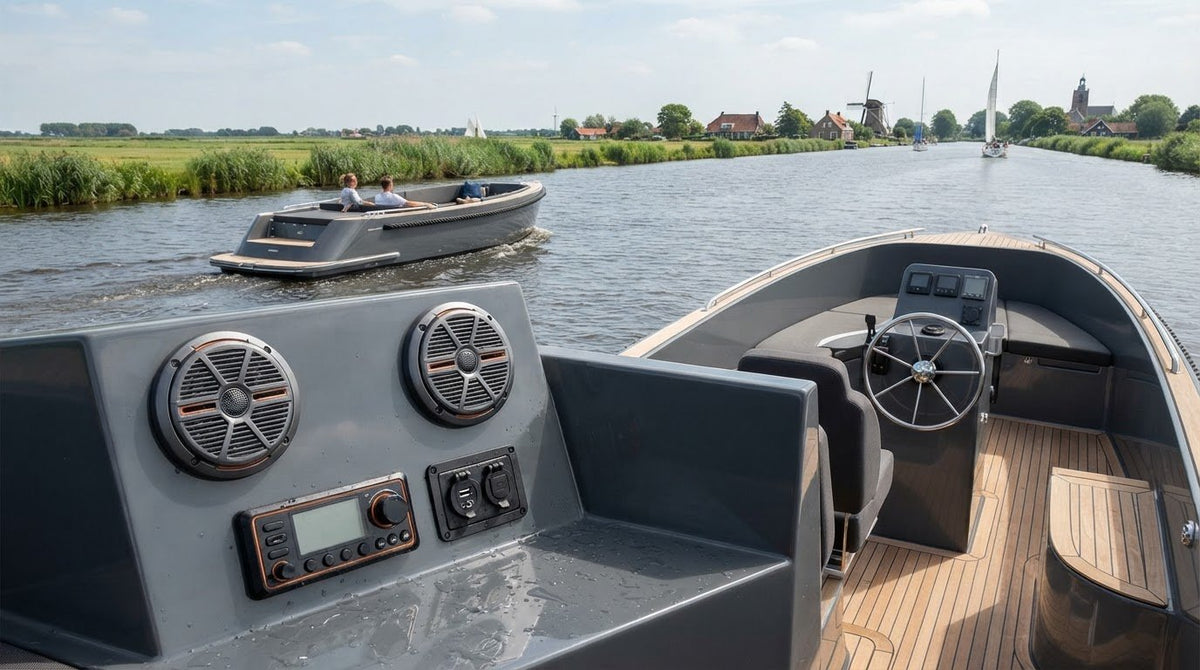
More speakers do not automatically mean better sound on board. For a small boat, two speakers are usually sufficient. In addition, choose a radio and connections that match your music sources, and equipment that is suitable for the conditions on board. This is how maritime audio on your boat forms a practical combination of operation, connection and clear sound.
You want to play music easily, but water, moisture and movement require different choices than at home. It also makes a difference whether you listen via Bluetooth, USB, AUX or radio, and how much space there is for speakers and cabling. The right setup starts with your boat and way of sailing, not with as much equipment as possible.
Discover which radio and connections suit your music, how to tune speakers to the available space and what you pay attention to when it comes to protection against the conditions on board. You can also read how an audio system can grow from a compact basic setup to a richer listening experience, so that you make well-informed choices.
Key points
- Choose Bluetooth, USB, AUX or radio based on how you want to play music while on the road.
- Adjust the number of speakers and the setup to the size of your boat; for a small boat, two speakers are usually sufficient.
- When choosing, pay attention to protection against water, UV radiation, salt and vibrations.
- Identify in advance which parts you need, so that you can put together a suitable complete installation.
- Discover which speakers suit your listening position and the room board.
Bluetooth, USB, AUX and other music sources
Choose your music source based on how you want to operate it on board. Bluetooth, USB, AUX and radio each offer a different way to play music.
Play music via Bluetooth, USB and AUX
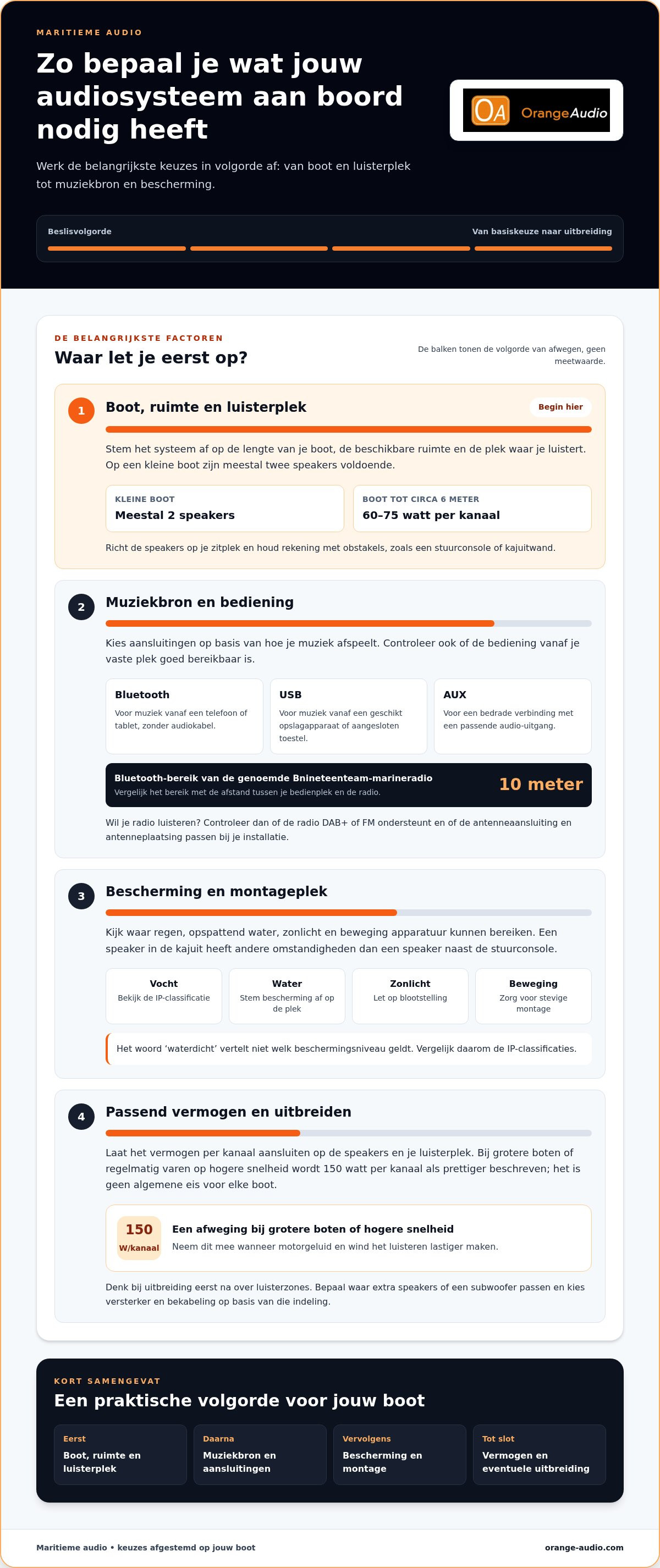
With Bluetooth you can play music from a phone or tablet, without an audio cable between the device and the radio. The range varies per radio and conditions on board can affect the connection. The wireless transmission range of the Bnineteenteam marine radio is 10 meters. Compare this with the distance between your regular control location and the radio.
USB is useful for playing music from a suitable storage device or connecting a device to the radio. Operation depends on the radio's connections and supported files. AUX works with a cable and is a simple option if your phone or music player has a suitable audiooutput. Before purchasing, check which connection your device uses.
Go through these three points:
- Choose Bluetooth if you usually play music wirelessly from a phone.
- Choose USB if you want to offer files via a connection.
- Choose AUX if you have a wired connection and a suitable output.
This will prevent you from having a choose a radio with connections that do not suit your daily use.
Boat radio with Bluetooth and DAB+
A boat radio with Bluetooth and DAB+ combines music from a paired device with radio broadcasts via DAB+. Check whether the radio has both functions and whether the connections match your installation. Also pay attention to the location of the controls. An easily accessible radio makes it easier to switch between music and radio on board.
If you want to use DAB+, check which antenna connection the radio has and where you can place the antenna. Reception partly depends on the antenna and the environment. FM can also come in handy if you want to use that reception source. Adjust your choice to where you sail and which stations you want to listen to.
Bluetooth, DAB+ and USB are therefore more than just individual ticks on a product list. First, determine whether you mainly use your phone, radio broadcasts, or stored music. Then compare the controls, connections and antenna options. This way you choose functions that match your listening habits, instead of options that you hardly use.
Test your setup before departure: connect your phone via Bluetooth, play music and test the radio reception. Also check whether an AUX cable or USB device is easily accessible. This way you can see whether the controls work comfortably from your seat and whether the selected source suits your maritime audio for the boat.
Adaptable audio systems for different boats
Adjust your audio system to the length of your boat, the available space and your listening position. A compact sloop requires a different layout than a larger boat with multiple seats.
Start with a simple floor plan. Mark where you usually sit, where the radio is located and which zones need music. According to the product information, two speakers are usually sufficient on a small boat. For a boat up to about six meters, a set of two speakers of approximately 60 to 75 watts per channel is sufficient. This way you have a concrete starting point without an unnecessary number of parts.
The placement partly determines how clear the sound sounds. Aim the speakers at the seat and take obstacles into account, such as a steering console or cabin wall. On an open deck you want to spread the sound across the place where you are staying. In a cabin, the space is smaller, so careful positioning is more important than simply adding extra speakers .
Next, look at the power per channel. It should match the speakers and the place where you are listening. For larger boats or regularly sailing at higher speeds, 150 watts per channel is described as more pleasant. That is not a general requirement for every boat. Use it as a trade-off when engine noise and wind make listening more difficult.
The circumstances also determine which speakers are suitable. Choose equipment intended for on-board use and check the specified protection against moisture, water and sunlight. The word 'waterproof' in itself does not indicate which level of protection applies. Therefore, compare the IP ratings and place components that match their protection. A sturdy mounting also helps to absorb movements while sailing.
Do you want to expand later? Then start with the listening zones and think about where additional speakers or a subwoofer logically fit. A powerful installation does not have to have the same volume everywhere. For example, with a separate zone you can operate the cockpit, while the sound in the cabin remains quieter. Choose the amplifier and cabling based on that layout, so that expansion remains manageable.
- Small boat: start with two speakers and check whether they reach your seat easily.
- Boat up to approximately six meters: compare the mentioned set of 60 to 75 watts per channel.
- Larger boat or higher speed: consider 150 watts per channel if listening comfort is important.
So first make choices about zones, placement and appropriate power. Next, explore equipment for marine audio that suits your boat and use.
Protection against water, UV, salt and vibration
Choose audio equipment designed for onboard use. An speaker in the cabin will have to deal with different circumstances than one next to the steering console. Therefore, first map out where rain, splashing water, sunlight and movement can reach the equipment. The mounting location determines which protection is important.
Start with water and moisture. View the IP rating of speakers, which indicates how well a device is protected against dust and water. Compare the specified classification with the location where you want to mount the speaker . A loudspeaker in a sheltered location will face different conditions than one speaker on an open deck. The term 'waterproof' alone does not indicate which level of protection applies.
Also pay attention to the differences between parts. An speaker that is resistant to moisture does not automatically make a radio, amplifier or connection suitable for the same location. Place sensitive parts where they come into less direct contact with water. Consider, for example, a radio behind a protected console and speakers in places where water is less likely to remain. Always follow the installation instructions of the device.
Sunlight also requires attention. Long-term UV radiation can damage or discolor materials. Therefore, check the information about UV resistance and choose the mounting location carefully. For example, an speaker under a console hood receives less direct sunlight than one on a completely open surface. A suitable cover can limit exposure, but does not replace the protection for which the device is designed.
Salt and vibrations play a role on Dutch inland waterways and on the coast. Salt can build up on surfaces and fittings, while the boat's engine and motion place stress on equipment and fixtures. Choose materials and connections intended for maritime use. Mount speakers firmly and support cables so that movement does not constantly pull on plugs or connection points.
Check these points before mounting:
- Location: note where water, sun and splashing dirt can reach the equipment.
- Specifications: compare the IP rating and UV resistance information per part.
- Mounting: securely mount the stereo, speakers and any subwoofers in appropriate locations.
- Maintenance: carefully remove salt residue and check connections and mountings regularly.
A system for maritime use therefore requires more than speakers that can withstand water. Assess the entire installation, from radio and wiring to mounting. This way you choose equipment that suits the conditions on board and adjust the sound to your sailing environment.
What does a complete audioinstallation for a boat in the Netherlands cost?
The total costs depend on the parts and the size of your installation. A basic setup with a radio and two speakers requires different equipment than a system with multiple listening zones and an subwoofer. So first make a parts list. This way you compare complete solutions instead of just individual devices.
Start with the source and operation. A boat radio with Bluetooth, DAB+ or USB is one part of the installation. Then look at the number of speakers and their power. For a boat up to about six meters, a set of two speakers of approximately 60 to 75 watts per channel is mentioned. A larger boat may require different choices.
The required reinforcement also plays a role. Check whether the radio can drive the speakers directly or whether you need a separate amplifier. That depends on the power and the number of speakers. Additional amplifier channels may be required for multiple zones. A subwoofer adds equipment and connections and requires a suitable place on board.
The assembly and materials also determine the total. The required cables depend on the distance between radio, amplifier and speakers. An installation with speakers at different ends of the boat requires more cabling than a compact setup. Also include protected connections and secure mounting. In addition, take into account any adjustments to panels or mounting locations.
Use these steps to properly compare quotes or system proposals:
- Note the parts: radio, speakers, amplifier, subwoofer and cabling.
- Describe the boat: list the listening positions, available space and desired zones.
- Compare the same setup: check that each proposal includes the same equipment and mounting.
- Ask about expandability: determine whether additional speakers or a subwoofer will fit later.
A low price for just the radio says little about the cost of a complete installation. For example, compare a two-speaker proposal with basic controls to a multi-zone system. Check which parts, cables and mounting are included. Also pay attention to the specified protection against water and UV radiation, so that you take on-board use into account when comparing.
Determine your budget based on the desired listening experience. First choose the functions you really use, such as Bluetooth or DAB+, and then determine how many listening places you want to control. For a compact boat, a simple set may suffice; multiple zones require more parts. This way you make a targeted choice without adding equipment or functions that do not suit your use.
Where do you buy or have maritime audio installed in the Netherlands?
Choose equipment and installation as one whole. A radio may have the right functions, but without suitable speakers, connections and placement you do not have a complete installation. Therefore, start with an overview of your boat, listening locations and desired music sources. This way you can specifically determine which parts suit your situation.
When purchasing, first check the dimensions and power supply. A standard DIN boat radio is 180mm wide, 50mm high and approximately 150mm deep. Measure the available space in your console before choosing a model. Also check the required power connection. For example, the Bnineteenteam marine radio works on DC 12V. Such information will help you prevent a radio from not matching the installation location or electrical installation.
Then make a parts list with the radio, speakers, any amplifier, cabling and mounting materials. Also note where the equipment will be located. A radio at the steering position requires a different cable route than speakers at the back of the cockpit. When installing, consider accessibility for operation and maintenance. Keep cables away from places where they can kink, chafe or get in the way.
An installation consists of more than securing equipment. The connections must match the radio and speakers, and the parts must fit together properly. With multiple listening locations you must also determine in advance which speakers play together. A simple two-speaker setup requires a different layout than a multi-zone system. Record your needs before selecting components.
Use this check when comparing a system or mounting plan:
- Space: measure the opening for the radio and available mounting locations for speakers.
- Connections: note which music sources and connections you want on a daily basis use.
- Setup: mark the listening locations and determine which speakers belong to them.
- Protection: compare the protection of each component with its location on board.
- Mounting: include cable routing, mounting and access to equipment in the plan.
If you want to assemble it yourself, work step by step according to the installation instructions of the equipment. Before connecting, check that the radio, power supply and speakers match. Then test each music source and listening position separately. This way you will immediately notice whether Bluetooth works from the control location and whether a speaker has been connected incorrectly.
Are you looking for equipment for use on the water? Then see which maritime models suit your boat, desired connections and installation plan. With this information you can make a targeted choice and prepare the installation without adding unnecessary components.
OrangeAudio: Bookshelf Speakers
OrangeAudio helps you choose the right speaker category for the place where you are listening. Bookshelf Speakers suits a compact indoor listening setup; for a larger space you can also view Floor Standing Speakers . If you want less separate equipment, compare Active speakers. Built-in speakers are suitable if you want to install speakers in a wall or ceiling.
The environment remains decisive for your boat: choose equipment that is suitable for the conditions on board. Therefore, use these speaker categories to explore your broader listening needs, for example for your home or a sheltered indoor space. This way you tailor your choice to the location and use, instead of using one type of speaker for everything.
View the Bookshelf Speakers of OrangeAudio and contact us to discuss your listening setup.
Prepare your choice for the next sailing season
Your next step is not choose equipment immediately. First make a note of where you want to hear music and how you operate the system on a daily basis. Also think about changes you expect later, such as an extra listening position or a different music source. With that starting point you can make targeted comparisons and avoid relying solely on individual functions.
OrangeAudio also offers Bookshelf Speakers, Floor-standing Speakers and Active speakers for listening places on shore. For your boat, the choice is about equipment that suits the environment and your use. View the maritime range and determine which parts match your sailing plans.
Do you want to discover which maritime audio suits your boat? View the maritime audio for your boat and take the first step towards music that accompanies your sailing. With a clear plan, you will more easily find a setup that works well, on board and during your next trip.
Frequently asked questions about maritime audio
Connections and data sources: what do I need?
First choose which devices you want to connect and compare their outputs with the inputs of the radio. The tuner functions themselves can also make a difference when listening to radio. The Bnineteenteam marine radio has FM reception from 87.5 to 108 MHz and AM reception from 522-1620 KHz. Use that data to determine whether the radio matches the channels you want to receive.
How many watts of power are needed?
The correct power does not only depend on the maximum wattage on the packaging. Also check the specified output power of the radio or amplifier and the load capacity of the speakers. If you usually listen quietly, this requires something other than music that must remain audible above wind and engine noise. Compare specifications on the same basis and match the parts.
Why special marine audio?
Marine audio is designed with onboard use in mind. This allows you to choose equipment that suits the placement and operation on your boat, instead of directly adopting a home system. For example, think about how you operate the radio from the steering position. An appropriate choice takes into account the installation as a whole, not just the sound of one speaker.
What does maritime audio for a boat mean?
Maritime audio for your boat is a sound setup that allows you to play music or radio on board. The installation can consist of a radio, speakers and additional components that suit your use. Unlike a separate portable speaker , this is a fixed setup that is connected to the chosen music source. This way you determine in advance where the controls will be located and which places require sound.
Which speakers are suitable for a boat and are waterproof?
Choose speakers of which the manufacturer clearly states the intended use and protection. Don't just look at the front: the back, connection points and mounting location also count. An speaker for a sheltered cabin is not automatically suitable for an open deck. Therefore, assess the specified properties of the specific model and the location where you will mount it.
How many watts and what speaker size do I need for my boat?
Let the available mounting opening, installation depth and space behind the panel determine the size. The same outer diameter may require a different recess. Adjust the power to the radio or amplifier and the volume at which you want to listen. Therefore, compare the technical data of both parts before ordering. This prevents a situation where an speaker physically fits, but does not fit properly electrically.
How do you connect boat audio to a 12V or 24V on-board network?
Check the supply voltage on each device separately, because the radio and amplifier do not have to use the same connection. Only connect equipment to an on-board voltage that falls within the specified power specifications. With a 24V on-board network you must therefore determine per component whether it is suitable for this. For deviating voltages, only use a suitable solution in accordance with the manufacturer's instructions.
Which IP certification and corrosion protection are required for audio on a boat?
Choose the IP classification based on the precise installation location and the exposure there. Also take metal parts, cable ends and mounting materials with you, because the protection of the speaker does not automatically say anything about all the parts around it. In a place where salt deposits, it is wise to include connections and fastenings in your maintenance round. Follow the manufacturer's instructions for cleaning.