
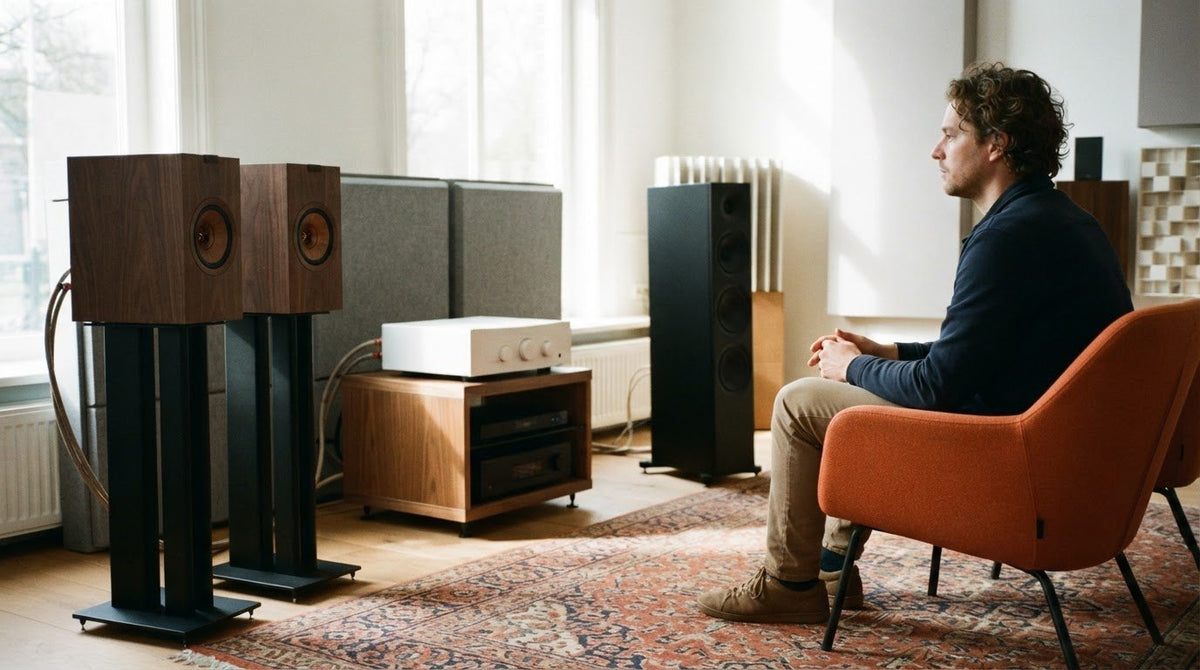
The best speaker is not necessarily the largest or most expensive, but the one that suits your room, listening distance and style of listening. Buying premium speakers therefore starts with comparing speaker types, connections and the choice between active and passive. This way you discover which features really make a difference for your situation.
It makes sense to first look at Brands and specifications. Yet a product name does not tell you whether an speaker will go well with your space or existing equipment. In this article you can read how to make that decision and which features will help you choose with confidence.
We look at the differences between bookshelf and floorstanding speakers, active and passive hi-fi and connections for your equipment. You can also read what to pay attention to in the listening room and how to tailor the options to your preferences. This way you not only compare individual functions, but the complete listening comfort you are looking for at home.
Key points
- Choose a bookshelf or floor standing speaker based on your listening room, distance from the speakers and desired placement.
- Compare the connections with your existing equipment. HDMI ARC can enable volume and on-off control through the television, but is not the same as eARC.
- Active speakers have a built-in amplifier; With passive models you choose the amplifier separately. Determine which setup best suits your preferences.
- For surround, choosing speakers from the same brand and preferably the same series can help limit differences in timbre.
- Rate speakers on properties that matter in your situation, not just on popularity or a rating.
Connections and wireless features
Start with the devices you want to connect. Do you use a television, record player, streamer or amplifier? Note which outputs and inputs are available for each device. Compare those connections with those of the speakers before choosing. This way, for example, you prevent a record player from not fitting directly into your chosen system.
A television can communicate with an audio system via HDMI ARC. HDMI ARC can enable volume and power control via the television, but is not the same as eARC. Therefore, check which HDMI connection your television and speaker support. Analog or digital connections may be important for other sources. Choose based on your own equipment, not just based on a connection list.
With wireless speakers, WiFi and Bluetooth are common ways to stream sound. WiFi is useful if you want to play music via a home network; Bluetooth is practical for a direct connection to, for example, a telephone. Also check whether the streaming services and controls suit your use. An integrated amplifier in an active speaker can make separate equipment unnecessary. The available connections determine how many other sources you can combine.
Do you want to hear music in multiple rooms? Then see whether the speakers can be part of a multi-room setup. You can control the display per room or let rooms play together. Pay attention to the network connection and operation: a stable WiFi connection allows wireless placement, while an Ethernet cable provides a wired network connection. Check out the options for multi-room audio if listening in different rooms suits your plans.
Wired or wireless is not a choice between good and not so good. Wired speakers require speaker cables and a suitable amplifier, but provide a hard-wired connection between the two. Wireless models reduce cables between source and speaker, although they still require power. When comparing, also take accessories such as cables, stands or wall brackets into account. Include this in your budget and consider where the equipment will be located.
A passive speaker itself is not wireless: it receives the signal via a cable from an amplifier. You can stream wirelessly to an amplifier that controls passive speakers. For example, you can combine a wireless streamer with passive speakers, while the connection between amplifier and speakers remains wired. At a listening distance of four meters you need different reserves than at two meters. So adjust the combination to the room and listening position.
With regard to warranty, returns and delivery, pay attention to the conditions, the returns procedure and the way in which large or heavy speakers are delivered. Also check whether you need to keep the packaging and accessories for a possible return.
What are the best hi-fi speakers?
The best hi-fi speaker suits your room, listening distance and music preference. Therefore, not only compare models, but also the placement, sound and amplifier you want to combine them with.
Floor-standing and bookshelf speakers
Bookshelf speakers usually take up less space and fit on a sturdy piece of furniture or a suitable stand. They are practical if you have little floor space or want to place the speakers close to furniture. Floor standing speakers take up more space, but provide a standalone setup without a shelf or stand. Measure the location in advance and take into account the distance to walls and listening position.
For a larger living room or a listening position further from the speakers a floor-standing model can be a logical choice. At four meters of listening distance, different reserves are required than at two meters. Also think about the music you often listen to and the volume at which you listen. For example, check out the floor standing speakers if you want to create a standalone stereo set.
Compare sound quality and specifications
Compare speakers by listening to the same music samples on both models. Pay attention to the intelligibility of voices, the placement of instruments and the balance between bass and treble. Use familiar music so that you recognize more quickly which sound remains pleasant. Also listen at a normal volume: a short demonstration at high volume does not tell everything about daily use.
Also view the sensitivity, impedance and specified frequency response. This data helps you tailor the speaker to your amplifier and usage, but does not in itself tell you what an speaker sounds in your room. Check whether the amplifier is suitable for the speakers and has the desired connections. So use specifications as a tool, not as a ranking.
Buy premium speakers in the Netherlands
In the Netherlands you can buy premium speakers at specialized hi-fi stores and Dutch online stores. Compare the range by type, connection options and information about the combination with amplifiers. Also check the conditions for delivery and returns in advance, so that you know how the purchasing process works. A clear product description makes it easier to compare models.
Do you want to listen to or demonstrate speakers at home? During a demonstration, listen to familiar music and ask for a comparison with a model of the same type. At home you can judge how the speakers sound at your listening position and with your equipment. Use the same music and approximately the same volume, so that the difference between models becomes clearer.
Which amplifier suits premium speakers? Choose one that matches the electrical properties of the speakers and provides sufficient power for your listening distance and desired volume. In addition, check whether the inputs match your sources, such as a record player or streamer.
Finally, include the entire stereo set in your comparison. A powerful floorstanding speaker is not automatically the best choice for a small room: placement and room acoustics influence the sound. Make a note of your listening distance, available space, favorite music and existing equipment. With this information you can compare models specifically and find a set that not only impresses during a demonstration, but also suits your daily listening moments.
Active and passive speakers
The choice between active and passive speakers determines how you put together the rest of your set. With active speakers, the amplification is in the housing; passive models work with a separate amplifier. Think in advance about the space you have, the desired connections and your equipment. This way you don't just choose an speaker, but a setup that works together logically.
An active set can remain compact: speakers, power supply and source together form the basis. Some models have connections for multiple sources, so you can combine a television and streamer, for example. Check which inputs are available per model and how you play music. If you mainly want to stream, pay close attention to the network functions and controls.
For passive speakers, choose the amplifier separately. This way you can tailor the combination to your listening habits, but you have to pay extra attention to the properties of both devices. Check that the amplifier is suitable for the speakers and has connections for your sources. Check which connections your record player and streamer need and whether your amplifier or speakers are suitable for them.
Compact active sets are useful if you have little space in the living room for separate equipment. You don't need a separate amplifier in addition to the speakers , but do take into account sockets and cables to the source. Place the speakers on a stable surface and point it at your listening position. This way you can first make a practical test setup before choosing the final location.
An subwoofer can supplement an active or passive set if you want more emphasis on low tones. Check that the speakers or amplifier have a suitable subwoofer output. Then place the subwoofer in a place where it sounds balanced with the main speakers. Change one thing at a time, such as position or volume, and listen to the same music sample to assess the effect.
For multi-room use, you also need to consider the controls and connection between rooms. An active set with network functions can independently receive music; with passive speakers this depends on the connected amplifier or streamer. Decide whether you want to hear the same music throughout the house or play different sources per room. Then choose equipment that suits it.
Finally, compare the complete setup, not just the speakers. Make a note of your sources, available connections, location in the living room and whether you want an subwoofer . Also consider whether you prefer to operate one compact set or combine separate components. This makes it clear which active or passive setup suits your daily use and which components you may want to expand later.

Brands and speaker types
In the Netherlands you will find premium speakers from, among others, KEF, Devialet and Focal. Compare Brands and models not only by name, but also by speaker type, placement and your listening preference.
Brands and models
Start with the type speaker that suits your listening room. Bookshelf models, floor standing speakers and active speakers each require a different location and setup. Then compare models within the same type. This way you can better see which connections, design and method of amplification suit your set.
Make a brief comparison per model: note the brand, type and where the speaker will be located. For example, consider bookshelf speakers on a piece of furniture versus floor-standing models next to the television. This way, a comparison between Brands and models becomes more relevant than a general preference for one name.
Available premium speaker brands
KEF, Devialet and Focal are Brands that you will find in the Dutch range. Compare the available speaker types per brand and see which model suits your space and equipment. A brand name alone does not tell you whether a specific speaker is suitable for your stereo setup.
If you are making a surround setup, choose speakers of the same brand and preferably from the same series. Differences in timbre can be noticeable when you mix Brands . Therefore, compare the speakers as a complete set and make sure that the chosen models are suitable for their role in your setup.
Use a fixed order to assess Brands . First choose between stereo and surround. Then decide whether you want bookshelf, floor standing or active speakers . Then compare models for features that count for your use, such as placement, operation and connection to your existing equipment. This way you prevent a striking model name from overshadowing the practical choice.
Even within one brand, models can be intended for very different situations. For example, a bookshelf speaker is suitable if you have little floor space; a floor-standing model requires a suitable place on the floor. Therefore, check how the speaker is placed in the room and which equipment you want to connect. Also take your listening preference into account: the music you often play makes comparisons more concrete.
For a stereo setup, compare two speakers as Pair, with the same source and amplifier. With surround you pay attention to the coherence between the front, back and center speakers. Choosing the same brand and series helps keep the sound consistent between positions. Make a note in advance of which speakers you already have and which components you want to add.
Finally, evaluate the model in the context of your entire system. Write down the brand name, speaker type, where the speakers will be located and the equipment you combine them with. Those points guide your comparison. This makes choosing based on Brands a practical step towards a coherent set, tailored to your preference and listening room.
Best rated hi-fi speakers
A high rating helps with comparison, but does not automatically tell you which speaker suits your listening room. Therefore, read reviews in addition to the specifications and always pay attention to the same points: use, setup and sound preference.
Start with the situation in which you want to use the speaker. Are you looking for a stereo pair for music, an speaker for the television or speakers for surround? A model that fits well with a movie setup is not automatically the best choice for music in a compact living room. Make your goal specific before comparing reviews.
Then read multiple reviews of the same model. Pay attention to recurring comments about, for example, intelligibility of voices, bass tones and the placement of instruments. One enthusiastic or critical response can mainly reflect a personal preference. If several listeners mention the same feature, it provides useful context, but no guarantee that you will get the same impression.
Reviews are only relevant if you know what they are based on. Note whether the writer placed the speakers in a similar room and what amplifier or source was used. A monitor speaker that is listened to close up is experienced differently than a floor-standing speakers in a spacious living room. Therefore, compare models under as similar conditions as possible.
Use these steps when reading product reviews:
- Check the application. Is it stereo, surround, movies or everyday listening?
- Find the listening context. Note the room, placement and used equipment.
- Read the notes. Pay attention to comments about connections, controls and desired sound balance.
- Compare with your own preference. A warm sound may appeal to you, while someone else is looking for detail.
With wireless speakers, reviews about Bluetooth, WiFi and controls are especially useful if you want to use the same functions. For example, see if a reviewer mainly streams directly from a phone or the speaker used in multiple rooms. For a stereo installation, the connection between both speakers and the connection to your source are relevant. This way you not only rate stars, but especially properties that suit your use.
Also take the space into account. A rating of an speaker in a large, open room says less about the sound in a small room. Make a note of where the speakers are and how far away you are from them. Compare that data to your listening position, instead of using ratings as a one-size-fits-all ranking.
The most useful rating is based on your listening goal. Make a short list of three points: application, desired functions and sound preference. Use that list to filter models and experiences. If you mainly want to listen wirelessly, compare wireless speakers for connection and operation, in addition to the reviews.
OrangeAudio: Bookshelf Speakers
OrangeAudio helps you choose a speaker type that suits your space and listening needs. Check out the bookshelf speakers for a compact setup, or compare floorstanding speakers if you have room for it.
If you want less separate equipment, check out active speakers. Built-in speakers are another option for tight integration into your interior. First determine where the speakers will be located, which sources you want to connect and whether you want to expand later. This way you can compare the options on practical points, in addition to sound and design.
Do you have your preferences clear? View the speaker types from OrangeAudio and choose which direction suits your hi-fi set. Contact OrangeAudio or visit orange-audio.com to discover the possibilities.
Prepare your choice for home
Take your listening needs to the next step. Make a note of what music you often play, what devices you want to connect and what you find important about the controls. This gives you a clear starting point for placing models next to each other. Buying premium speakers becomes easier once your choice fits your daily listening moments.
Use your notes to make targeted comparisons and see how different setups suit your needs. Discover suitable listening options and take the time to determine what works best for you.
A good choice does not have to be complicated. Start with what you want to hear at home and let that drive your comparison. This is how you build a hi-fi setup step by step that really suits your way of listening.
Frequently asked questions
What is the best speaker?
The best speaker supports your favorite listening moment. Make a practical profile for your choice: do you usually listen quietly in the background, or do you consciously give music all the attention? Also note whether you often listen alone or with others. Rate models for listening comfort and operation based on those preferences. Then see which choice remains pleasant during normal days at home.
What do premium speakers cost in the Netherlands?
The costs depend on the speaker type, the finish and any additional equipment, such as an amplifier or subwoofer. Therefore, compare complete sets and include connections and accessories in your consideration. Free same-day shipping only applies within NL, BE and DE for orders before 6:00 PM that are in stock. The store has free parking directly in front of the door. Payment details are processed securely and not stored; OrangeAudio has the Thuiswinkel Waarborg web store quality mark. All product reviews shown are from customers who have purchased the product.
What are the best premium speakers for home use?
KEF, Focal and Devialet are examples of Brands that you can include in your home comparison. The best choice depends on the space and use: listening to music requires a different setup than watching movies with multiple speakers. Also consider the available space and your existing source equipment. Select models that match and then compare their connections and sound.
What is the difference between floorstanding, bookshelf and active speakers?
You will especially notice the difference when you plan your set. Measure the available space and determine where cables and power supplies can run. Then check whether your existing equipment can be connected to the chosen speakers and what parts you may still need. This way you can compare the practical consequences of each type for your room and daily use, without relying solely on appearance or model name.
What are premium speakers?
Premium speakers are hi-fi speakers that you choose based on your room, listening distance, connections and listening preference.