
Do you want a simple setup without sacrificing a sound system that suits your listening habits? Active speakers have a built-in amplifier. 'Wireless' says something about the connection between devices. These terms are often confused, which makes buying active speakers seem more difficult than necessary. It is also not always immediately clear whether you can connect a television, computer or record player.
A suitable system fits your space, your equipment and the way you listen on a daily basis. Therefore, do not start by comparing all specifications, but with A pair practical questions: which sources do you use, which connections do you need and how much simplicity are you looking for? In this article you will discover step by step what to pay attention to. We discuss the difference between active and wireless speakers, the connection of your equipment and the influence of your listening position. This gives you an overview and allows you to choose a complete listening solution that suits you.
Key Points
- Active speakers have built-in amplification. This way you can recognize when this setup suits your listening needs.
- Start with your listening position, use and main sound source. Then choose a size and placement that suits your room.
- Compare the outputs of your equipment with the inputs of the speakers. This way you can see which connections you need.
- Buying active speakers is all about the trade-off between ease of use and the freedom to choose separate components.
- Use the checklist to assess the size, connections and suitability for your equipment per model.
What are active speakers and what makes them useful for at home?
Do you want to combine separate components, or would you rather start simply with a listening setup? Active speakers have built-in amplification. So you don't have to add a separate amplifier to the speakers. You do need a suitable source, such as a television, computer, record player or streamer, and a suitable connection between that source and the speakers.
Because you need fewer separate components, the setup can be clearer. You also have less equipment to set up and operate. Yet the word 'active' does not tell you which sources you can connect, how you adjust the volume or how the system fits in your room. This varies per model. Anyone considering buying active speakers would therefore do well to consider the listening position and use in addition to convenience.
How does the built-in amplifier work?
With active speakers, the amplification is in the speaker arrangement. The signal from your source is made suitable for listening through the speakers by the built-in amplification. A separate amplifier is therefore not automatically necessary. What other devices you need depend on your source and the connections and controls of the model you choose.
Active sets vary. Therefore, check per model how you play music and which connections are available. A television may require a different connection than a computer or record player. The volume control can also differ per setup. This way you assess the practical use instead of just relying on the general promise of convenience.
Active, wireless and passive: what do those terms mean?
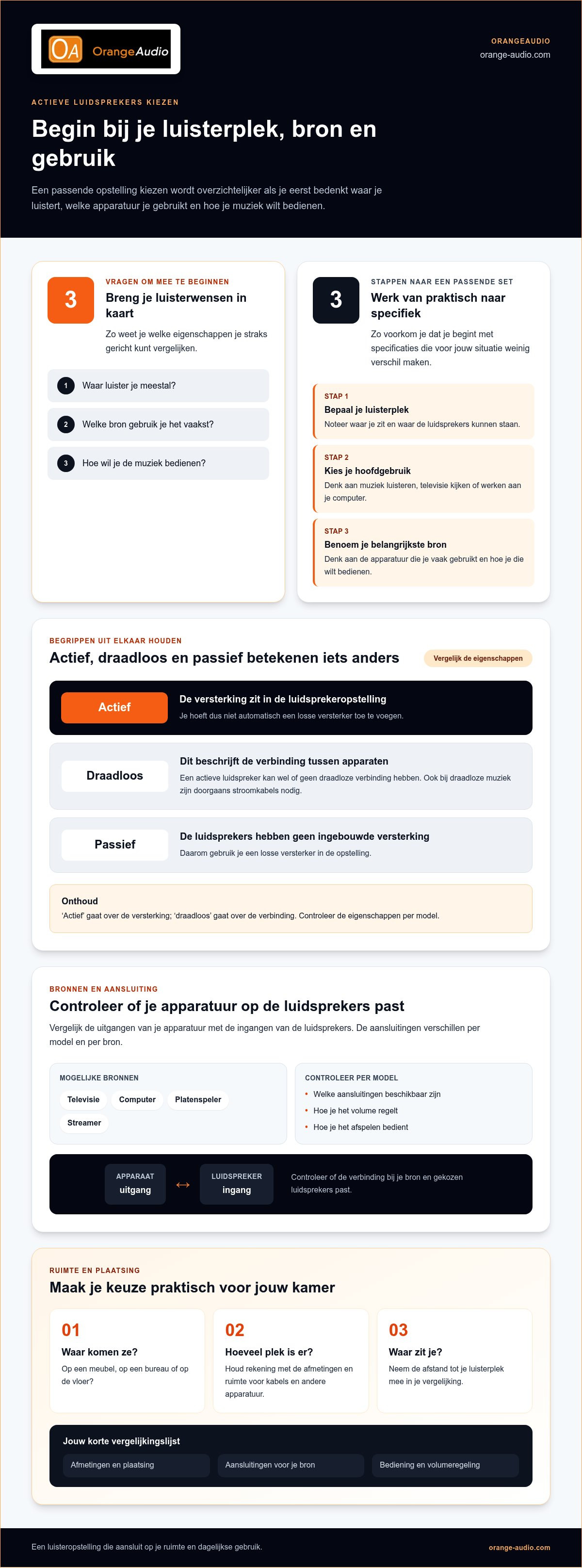
Active describes where the amplification is: it is built into the speaker setup. Wireless describes how devices can connect to each other. An active speaker may or may not have a wireless connection. And even if a model receives music wirelessly, power cables are usually still required. Other connections may also require cables. Therefore, view the connections per model.
Passive speakers do not have built-in amplification. You use a separate amplifier in the setup for this. The practical differences are discussed later. Above all, remember that “active” and “wireless” describe different properties. So don't let your choice be guided solely by a product label.
Make your choice concrete with three questions: where do you usually listen, which source do you use most often and how do you want to operate the music? Think of music from a computer, records from a record player or sound from the television. Such daily situations make it clear which connections and functions are important to you. You can then compare models specifically and ignore features you don't need.
Convenience is valuable if it suits your habits. A compact setup can be useful if you want to combine a small amount of equipment, but your choice also depends on the available space and your listening purpose. So there is no one type of active speaker that is suitable for everyone. Start with how you listen at home and then check whether the connections match your equipment.
Which active speakers suit your room and listening use?
Don't just choose based on size. First determine where you usually listen, what you use the speakers for and which source you turn on most often. This makes it clear where the system should be located and what you expect from it on a daily basis. For example, a set next to your computer requires different practical considerations than speakers for music in the living room.
- Determine your listening position. Note where you sit and where the speakers can be placed.
- Choose your main use. Consider listening to music, watching television or working on your computer.
- Name your main use. source. Think about the equipment you use most often and how you want to operate it.
With this order you avoid starting with specifications that make little difference to your situation. You can then compare models specifically based on dimensions, placement and connections.
Start with your listening room and placement
First look at the available space. Will the speakers be placed on a piece of furniture, on a desk or on the floor? Also take into account the distance to your listening position and the space for cables and any other equipment. If necessary, measure the available width and height. This allows you to practically compare models without assuming that one size is ideal for every room.
A compact setup can fit well on a desk or piece of furniture with limited space. Also view the bookshelf speakers. If you have more space or want to place the speakers somewhere else, take the dimensions and desired placement into account in your comparison. The layout of your room also determines what is practical.
Adjust the choice to what you listen to most often
Your daily use helps determine your priorities. If you mainly listen to music, pay attention to how you connect your music source and how you control playback and volume. If you mainly use the speakers with the television, start with the audiooutput on your TV and the appropriate input on the speakers. For computer use, placement and operation from your workstation are also important.
Write down your main source and use before comparing models. A record player, television and computer may each require a different connection route. Connections and features vary by model, so check the details of the speakers you are considering. Don't just choose based on your favorite music genre either. Your source, space and way of listening are more practical starting points.
- For music: determine which source you use and how you control the music.
- For television: check which audiooutput your TV has and which input matches the speakers.
- For you desk: take into account the available space and controls within reach.
This gives purchasing active speakers a concrete starting point: start with the room and listening position, then determine the use and then compare the data per model. View the range and tailor the dimensions and connection options to your situation.
Which connections do you need for your active speakers?
First make a list of the devices you want to use. Note the available audiooutputs for each source and compare them with the inputs of the speakers. This way you can see whether you can connect devices directly or whether an additional part is needed. Connections vary by model, so don't just rely on the name or appearance of the speaker.
Use the table to map your connections. The connections mentioned are examples. Consult the manuals to check which connections your equipment actually has.
| Source | Connection to the source | Input on the speaker | Point of attention |
|---|---|---|---|
| Television | For example HDMI ARC, optical or RCA | A corresponding input | Check that the TV is sending sound through the selected output and that the speaker supports that connection. |
| Computer | An available digital or analogue audiooutput | A matching input | Compare the connections of the computer and speaker. |
| Streamer | For example RCA or a network connection | A suitable input or supported network connection | The chosen connection must be supported by both devices. |
| Record player | The audiooutput of the record player | A suitable input, possibly with phonopre-amplification | Check whether the signal route requires phonopre-amplification. |
| Subwoofer | A suitable output on the loudspeaker | A suitable input on the subwoofer | Check whether the connections of both devices match each other. |
Connect to a television, computer or streamer
For a television, check in the manual which output transmits sound and which sound settings are associated with it. This prevents you from choosing a connection that does not match the set sound output. If you are using a computer, check which audiooutput is available. With a streamer, you decide whether you want to use a cable connection or a supported wireless connection. HDMI ARC, optical, RCA, Bluetooth and Wi-Fi are examples of possibilities, but not every model has them all.
Streaming convenience depends on the devices you combine. So check whether both the speaker and the source support the desired connection. This way you prevent a function you are counting on from not working in your setup.
A record player or subwoofer Add
A record player must provide a signal that is suitable for the input of the speaker. If the turntable or other component in the setup does not have a suitable phonopre-amplification, a Phono‑Vorverstärker may be required. This amplifies the weak signal from the record player to a level suitable for a standard input. Therefore, check which pre-amplification is already present in your equipment.
You can add an subwoofer if the speakers have a suitable output and the connections of the subwoofer match. If you want to include that option in your choice, take a look at the subwoofers for your listening setup and compare the connections with those of the speakers.
Finally, make a connection list for your entire system: source, output, any intermediate equipment and input of the speakers. Also think about extensions that you want to add later, such as a record player or subwoofer. This way you judge models on connections you really need and prevent you from choosing based on functions you don't use.
Active speakers or a separate amplifier: which setup suits you?
The choice is mainly about simplicity or freedom. In an active system, the amplification is in the speaker setup. With separate components, you choose the amplifier separately and put together the setup yourself. Neither is automatically the best choice for everyone. Think about your existing equipment, the connections you need and how many separate devices you like.
| Part | Active speakers | Speakers with separate amplifier |
|---|---|---|
| Amplification | Integrated into the speaker setup | Provided by a separate amplifier |
| Equipment required | A suitable source and the speakers | A suitable source, amplifier and speakers |
| Connections | Connect source to the inputs of the speakers | Connect source to the amplifier and amplifier to the speakers |
| Expandability | Depending on model connections and features | Select and replace components individually |
The table shows the outline of the structure. Always check the connections and compatibility of the devices you want to combine. For example, an existing amplifier may be a reason to use it in your new setup, as long as the intended speakers and sources match. Do you already have equipment? Then make a note of the connections and determine which parts you want to keep before comparing models.
When does an active system suit you?
An active system can be a good fit if you want a well-organized setup with less loose equipment. You connect a suitable source to the speakers and keep the set compact. This is useful if you do not want to choose or install an amplifier separately. The connections differ per model. So check whether your main source fits and whether the controls match how you listen at home.
If you want to buy active speakers, weigh the convenience against the parts you already own. A set that fits your daily use is more practical than a setup that only seems simple on paper.
When do you want to consider separate components?
A separate setup can make sense if you already have an amplifier that you want to continue using, or if you want to consciously choose components individually. You must then coordinate the parts and their connections. That requires more individual choices. If you want to compare amplifiers further, also read the guide to buying a hi-fi amplifier.
First identify what you want to keep and which source you connect. Then compare both setups for the required equipment and connections. If wireless options also count, view wireless speakers as a separate option. Wireless and active do not mean the same thing, so judge these characteristics separately.
How to choose and buy active speakers with confidence
A suitable choice does not start with the longest list of technical data. Start with what you want to hear and use every day. Then go through your setup step by step. This way you can see per model whether the speakers suit your listening purpose, the available space and the equipment you already use.
Use this checklist before you choose
Go through the points in this order. Record your answers by model so that you compare candidates on the same practical criteria.
- Start with your listening purpose. Determine whether you use the speakers mainly for music, television or computer use.
- Note your main source. Write down which device you use most often and how you want to control playback.
- Determine the location. Look at where the speakers will be placed and how much space is available there.
- Assess the size. Compare the dimensions of the speakers with the location and layout of your room.
- Weigh features based on everyday usefulness. Ask yourself whether a feature actually supports your listening experience or operation. More specifications are not automatically better.
- Consider your other equipment. Do you want to use a record player, streamer or subwoofer or add it later? Take that into account in your choice.
- Finish with the connection check. Compare the outputs of your source with the inputs of the speakers and check whether the connections fit.
A candidate does not have to offer the most options at every point. Choose the set that supports your sources, fits logically in your space and is pleasant to use every day. This way you compare complete setups instead of individual functions.
Make your choice a complete listening setup
Tune the speakers to the equipment you actually use. A television that you turn on every day, a record player that you listen to regularly or a streamer for music always requires a suitable place in the setup. Therefore, look at the whole and do not choose functions that add little to your use. For a broader look at the relationship between sources, amplification and speakers, you can also consult the guide to building a hi-fi system.
Keep your checklist at hand when comparing models. Discover the active speakers at OrangeAudio and see which ones suit your listening purpose, space and equipment.
Make room for your listening moments
A listening setup is more than a collection of devices. It is part of your daily rhythm: an album that you sit down to listen to, a movie night or music in the background while you are busy. Therefore, choose with an eye for how you use the speakers and what is comfortable for you at home. This way, buying active speakers is not a competition in specifications, but a step towards a system that suits your life.
Take the time to compare models. Consider how they will be placed in your room and how you will use them with your familiar equipment. A good choice does not have to be complicated. If you know what is important to you, you can discover which options suit your needs.
OrangeAudio is specialized in hi-fi. View the range of active speakers and find inspiration for your listening room. Discover the active speakers at OrangeAudio.
Frequently asked questions about active speakers
Do active speakers always have built-in amplification?
Yes, active speakers have built-in amplification. So you don't have to choose and place the amplifier as a separate device. Keep the set manual so that you can later find out how to operate the speakers and which parts are included in the setup. This is useful if you rearrange your equipment or replace a source.
Are active speakers always wireless?
No, active does not automatically mean that the connection to your sound source is wireless. If you want to listen wirelessly, check which connection options the speaker model offers and whether your source works with them. Also consider how you use the system on a daily basis: do you want to play from one fixed device or be able to use different sources? This way you determine which wireless functions are useful to you.
Can you connect active speakers to any television?
No, not every combination works automatically. Make a note of the make and model of your television and consult the manual for the available audiooutputs and settings. Also consider how you want to control the volume, for example with the television remote control or via the speakers. This way you assess not only whether you can play sound, but also whether the daily operation suits you.
Can I connect a record player directly to active speakers?
Sometimes, if the record player and speakers together provide a suitable signal route. If the record player has a built-in phonopreamplifier, it can amplify the weak signal to a level suitable for a regular audioinput. If this reinforcement is missing, a separate Phono‑Vorverstärker may be required. Check the connections and any selector switch on your record player and follow the instructions in the manual.
Can I later add an subwoofer to active speakers?
This is possible if the speakers and subwoofer have suitable connections. First consider what you want to achieve with the expansion and how much space you have for it. An subwoofer is an additional part to install and adjust, so take that into account when making your choice if it suits your listening needs. Keep the manuals for the speakers and subwoofer together so you can find the settings later.
Are active speakers suitable for a small room?
Active speakers may be suitable for a small room. The room size alone does not determine which set is right for you. Also think about where you usually sit, where the speakers might be placed and what functions you use at home. Don't choose a model just because it has a lot of features. An overview of your listening habits helps you distinguish useful functions from options you probably don't need.
Do I need a separate amplifier for active speakers?
Usually not. The amplification is already in the active speaker system, so a separate amplifier usually does not have to be part of the setup. If you already use an amplifier, first decide whether you want to keep it and what role it will play. Connect devices according to the manufacturer's instructions and check that the connection you choose is suitable.