

The best outdoor speakers choose a canopy based on the connection, exposure to moisture and the size of the room. Active speakers have a built-in amplifier; passive speakers connect to a suitable amplifier. The right choice therefore depends not only on the size, but also on the equipment you want to use.
You want to enjoy clear sound outdoors, without discovering afterwards that the connection does not fit or that the speakers are not suitable for the place where they are installed. This requires more than just choosing a model that looks nice.
In this article you can read how Bluetooth, WiFi and wired connections differ from each other, what to pay attention to when it comes to water resistance and how active and passive speakers work. You will also discover how the dimensions and layout of your canopy are taken into account: this way you determine whether one speaker is sufficient or whether you have to distribute the sound across the room. With these points of interest, you can choose speakers that suit your outdoor space and the listening experience you are looking for.
Key points
- First choose how you want to play music: wirelessly, via WiFi or with a wired connection.
- Pay attention to the placement and water resistance, so that moisture does not enter the speaker remains.
- Determine whether active speakers with built-in amplifier or passive speakers with a separate amplifier suits your setup better.
- Select the size and number speakers depend on the size and layout of your canopy.
- Compare the different speaker types and connections to choose a setup that suits your outdoor space.
1. Bluetooth, cable, WiFi and FM radio
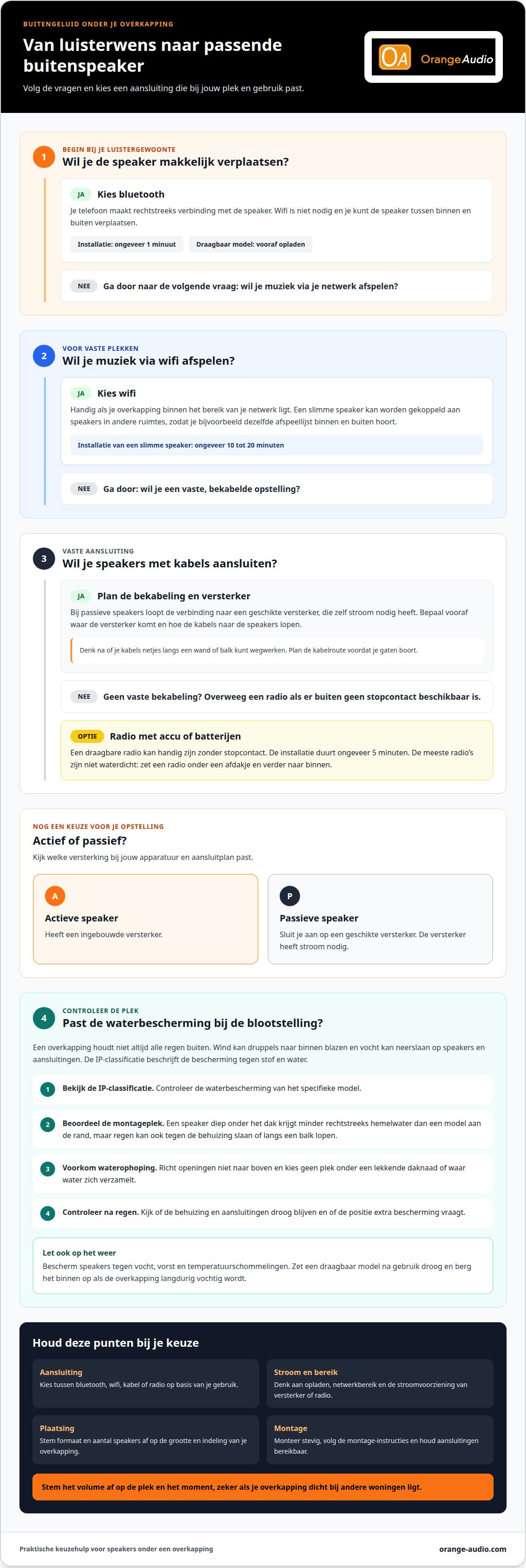
Choose the connection based on where your music comes from and how you use the canopy. A Bluetooth speaker is easy to move between indoors and outdoors and does not require WiFi. Your phone connects directly to the speaker. Keep in mind that a portable model must be charged before you play music.
If you want a landline speakers, look at the wired connection. With passive speakers , the connection is to an amplifier, which itself needs power. Consider in advance where the amplifier will be placed and how the cables will run to the speakers . This way you can immediately see whether you can neatly conceal the cabling along a wall or beam. Anyone who has a custom wooden outdoor accommodation designed or built via, for example, jouwdroomoverkapping.nl, can include power points and cable routes directly in the beam structure. This is more important with a fixed system than with a separate Bluetooth speaker.
Wifi is useful when you want to play music over a network. A smart speaker can also be linked to speakers in other rooms for a multi-room setup. For example, you can play the same playlist inside and under the canopy. Installing a smart speaker takes about 10 to 20 minutes. Choose WiFi if your canopy is within range of your network and you want to use the speakers at a fixed location.
Bluetooth suits flexible use, for example when you bring the speaker back inside after listening. The installation takes approximately 1 minute. A portable radio with a built-in battery or batteries is another option if there is no electrical outlet available outside. Installing a radio takes about 5 minutes. Most radios are not waterproof, so place such a model under a shelter.
When playing music outside, take into account noise regulations and possible nuisance to local residents. Adjust the volume to the place and the moment, especially if your canopy is close to other homes.
The price of outdoor speakers depends on the type, the number of speakers and any additional equipment, such as an amplifier. A separate Bluetooth speaker requires a different setup than a fixed speakers with cabling. Therefore, compare complete solutions instead of just individual solutions. speakers.
Mount speakers firmly in a suitable place under the canopy and plan the cable route before drilling holes. Follow the installation instructions of the speaker and avoid allowing water to remain in it, as this can cause damage in the long term. Keep connections accessible for maintenance or to disconnect equipment.
Make your choice step by step: first determine whether you want flexible listening or a fixed setup. Then choose between Bluetooth, WiFi, cable or radio. Then think about charging, network range, power supply and the route of any cables. The best outdoor speakers for a canopy are not automatically the most extensive, but suit your listening habits and the practical possibilities of the location.
2. Water resistance and IP rating
A canopy does not always keep out all the rain. Wind can blow droplets in and moisture can settle on speakers and connections. Therefore, check the IP rating before choosing a model. This describes the protection against dust and water. Not every place requires the same water protection: the degree of exposure determines what is appropriate.
First distinguish between a sheltered place and an open side. A speaker deep under the roof receives less direct rainwater than a model on the edge. Yet rain can hit the housing there or run along a beam. Therefore, pay attention not only to the mounting location, but also to the route of water droplets and the position of the connections.
When mounting, prevent water from remaining in the speaker. Orient the speaker so that openings do not point upwards and water can flow away. Do not place it under a leaking roof seam or in a place where water collects. After a heavy rain shower, check whether the housing and connections remain dry. This way you will notice in time whether the chosen position requires extra protection.
Many Bluetooth speakers are waterproof, which can be useful in unexpected rain. Always check the IP rating of the specific model. This indicates a level of protection, but does not automatically mean that the speaker is suitable for every outdoor condition. Place a portable speaker dry after use and store it indoors if the canopy becomes damp for a long time.
Protect speakers against moisture, frost and temperature fluctuations by mounting them in a sheltered position and preventing water accumulation. Check the housing, cable entries and connections regularly, especially after wet or cold weather. Move a portable model indoors when you are not using it.
A radio requires a different approach: most radios are not waterproof and are therefore best placed under a shelter. This protects against rain from above, but not always against wind-driven drops. Place the radio further inside and keep the connections dry. Use the IP rating as a selection point for fixed speakers and also match the mounting location to the circumstances.
Make your choice with this practical order:
- View the IP rating of the speaker and pay attention to protection against water.
- Determine whether the mounting location is directly exposed to rain or splashing water. gets.
- Choose a position where water does not remain in the housing.
- Check after rain whether speaker and connections remain dry.
Assess the best outdoor speakers for your canopy, not only in terms of noise, but also in the place where they hang every day. A sheltered installation, appropriate water protection and attention to moisture help you make a choice that suits your outdoor space.
3. Active or passive speakers
The choice between active and passive speakers determines how you build the installation. An active speaker has a built-in amplifier, so you don't need an external amplifier to amplify the sound. A passive speaker does need that reinforcement. Connect it to a suitable amplifier that provides sufficient power for the chosen speakers.
Start with the equipment you already have. Do you have an amplifier that fits the passive speakers ? Then a passive setup can logically connect to your existing installation. If you do not want to install a separate amplifier, active may be a clearer solution. The amplifier is then in the speaker itself. Consider where you get power from, so that you can plan the placement and connection in advance.
With an active/passive speaker set, one speaker is connected to the power supply. This differs from a set with two passive speakers, where the amplifier requires power. Before purchasing, draw out the parts: make a note of where the amplifier will be located, where the speakers hang and which cables run between them. This way you can see whether the setup suits the available connection points.
Use these steps to make your choice clear:
- Choose active if you want a built-in amplifier and do not need a separate amplifier.
- Choose passive if you have a suitable amplifier or want to consciously include it in the installation.
- Determine where power is available, at the speaker or at the amplifier.
- Map the necessary connections before you finally install the speakers permanently installed.
Also pay attention to the combination of speaker and amplifier. For passive use, they must match each other, so the connection alone is not enough to determine your choice. Also consider the controls: do you want to operate the amplifier indoors, or is it in a place where you can easily reach it? A fixed roof requires a different practical layout speakers that you move regularly.
With active speakers the amplifier is incorporated in the speaker , but the location remains important. A nearby socket can determine where the speaker is best hung. With passive speakers , the power supply is at the amplifier, but you must carefully plan the connection to the speakers . Both systems can fit: the best choice depends on your equipment, power points and desired installation.
Summarize the decision in one practical question: where do you want the amplification to take place? Only then choose the speaker setup. This way you avoid buying active speakers without a suitable power supply, or passive speakers without a suitable amplifier. If you already have an amplifier for your canopy, passive is the obvious choice. Active can be connected more easily without a separate amplifier.
4. Adjustment of speakers to the size of the canopy
In an open canopy, sound waves escape to the outside more easily than in a partially enclosed space. Therefore, choose based on the listening positions and sound distribution, not just on speaker size. Surface-mounted speakers can often produce more powerful sound than ceiling speakers. Ceiling speakers are ideal for background music that sounds evenly throughout the room.
Start with a simple floor plan. Mark where you usually sit, where the dining table is and which sides are open. An speaker above one corner may sound bright there, but appear softer on the other side. First map out the listening locations, so that you do not only choose based on appearance or available mounting space.
With a large canopy, larger or more speakers may be needed to properly distribute the sound. That does not automatically mean that you need one extra large speaker. Multiple speakers can distribute the music over different parts of the room. For example, consider the difference between a long canopy with seats at both ends and a compact seating area around one table.
For an open canopy, speakers that distribute the sound over the seats are often a practical choice. Place them so that the music is not just focused on one chair. In a partially enclosed canopy, ceiling speakers can be suitable for background music, while surface-mounted speakers can provide more powerful sound. The best solution depends on the desired listening experience and the shape of the room.
Use these steps to determine the layout:
- Draw the exterior walls, open sides and fixed seating areas on a floor plan.
- Determine whether you mainly want background music or more emphatic sound.
- Choose ceiling speakers for dispersed background music, or look at surface-mounted speakers for more powerful sound.
- If you have a large room, consider multiple speakers for a wider distribution.
Also pay attention to the height and direction of mounting. A speaker pointing directly at one seat can sound stronger there than elsewhere. Therefore, aim the speakers at the shared listening area and take beams, lighting and other obstacles into account. Free placement helps spread the sound throughout the room.
Test the chosen setup where possible before final installation. Turn on music from your usual seat and then listen from other places. If you notice major differences, adjust the direction or position. With two speakers you can distribute them across the room instead of placing them next to each other.
Match the speakers to the shape of your canopy: open or partially enclosed, compact or large, with one seating area or multiple listening areas. First determine where the sound should come from. Then choose the type and number of speakers that can serve those places.
5. What are the best weatherproof outdoor speakers for a canopy?
The best outdoor speakers suit the location, the exposure to rain and your listening needs. Therefore, do not start with the appearance, but with the conditions under your canopy. A speaker hangs more sheltered under a deep roof than on an open edge. That position determines how much protection against moisture is needed.
Use the IP rating as the first selection point. This indicates how an speaker is protected against dust and water. Compare each model's rating to where you plan to mount it. Also look at open sides, possible splashing rain and the route along which water can run. A canopy does not provide the same shelter everywhere.
Then assess the housing and installation. Choose a sturdy spot where the speaker is not exposed to leaking water or prolonged wetness. Place it so that no water remains in it. Also consider the connections: route cables in such a way that moisture does not come along the cable at the connection. When mounting, follow the manufacturer's instructions.
Suit the type speaker to your use. For quiet background music, an even distribution across the room can be nice. Surface-mounted speakers can often produce more powerful sound than ceiling speakers. With a large canopy, larger or more speakers may be required to properly distribute the sound. So don't just choose based on size, but also on the listening locations.
Check these points before you make a choice:
- View the IP rating and compare it with the exposure to water.
- Identify open sides, eaves and possible splash rain.
- Choose a mounting location where water does not remain in the speaker
- Match speaker type and quantity to the size and layout.
- Check whether the connections and cable route suit the chosen location.
Portable Bluetooth speakers require a different consideration than fixed outdoor speakers. Many Bluetooth speakers are waterproof, which can be useful in unexpected rain. However, the classification of the specific model determines the protection. A radio is generally less suitable for an open place: most radios are not waterproof and are best placed under a roof.
Finally, make a distinction between weatherproof and invulnerable. Prevent moisture from accumulating and check the housing and connections after rain. Move a portable model indoors when not in use. Judge the best outdoor speakers for your canopy based on protection, placement and sound distribution. This way you choose a solution that suits your outdoor space and use.
Ceiling speakers are suitable for background music in one or more rooms and are often distributed throughout the room. For a portable Bluetooth speaker, consider the power supply and charging status.
OrangeAudio: Bookshelf Speakers
OrangeAudio offers Bookshelf Speakers for those considering a compact speaker setup. For use under a canopy, placement is especially important: choose a sheltered spot and adapt the model to the circumstances. A bookshelf speaker is not automatically intended for outdoor use, so pay attention to the protection and mounting suitability of the chosen model.
If you want fixed speakers on the wall, then also compare the available Outdoor Speakers. Active speakers can fit if you do not want to use a separate amplifier. Built-in speakers are another option for a quiet, integrated setup. Make your choice based on the openness of your canopy, the power supply and the desired sound distribution.
View the Bookshelf Speakers of OrangeAudio and determine which setup suits your space. Would you like to discuss your options? Please contact OrangeAudio.
Give your outdoor space your own listening plan
A nice listening place starts with a choice that suits how you want to experience music outside. Don't just think about the speakers, but also about the whole thing: where are you sitting, how do you use the space and do you want to expand the music to other rooms later? This makes it easier to choose the best outdoor speakers for your canopy and find a solution that suits your needs.
OrangeAudio offers Bookshelf Speakers, Floor-standing Speakers and Active speakers. With these categories you can explore different speaker setups. Determine which shape and connection suit your situation and discuss how your wishes fit in with an outdoor solution.
Would you like to discuss your ideas and options together? Ask OrangeAudio for personal advice and discover which direction suits your roof. With a clear plan, you can make outdoor listening a natural part of your home.
Frequently asked questions about outdoor speakers
What IP rating is required for speakers under a canopy?
The required IP rating depends on how much rain and moisture the speaker can reach at its mounting location. A model under a deep eaves looks different from one speaker on an open side. Therefore, compare the specified protection of the model with the conditions at that location. Also pay attention to connections and cable entries: they can trap moisture, even if the speaker housing is sheltered.
What is the difference between passive and active outdoor speakers?
Active speakers have a built-in amplifier; passive speakers require a suitable separate amplifier. Before you choose, check what equipment you already have and where it can be located. An existing amplifier may be a reason to consider passive speakers . If you do not have a suitable amplifier, an active setup can limit the number of separate parts. Also take into account the available power points.
Which outdoor speakers are suitable for WiFi, Bluetooth or multi-room?
The choice depends on how you want to control music and whether you want to connect the canopy to other rooms. Choose a smart speaker for a multi-room setup if you want to play music in multiple rooms. Bluetooth fits a portable speaker that you also use indoors. For example, choose Bluetooth for flexible use in different places, or WiFi to add the outdoor space to your existing listening setup.
How do you choose the right power and size for a canopy?
Choose the size and number speakers based on the listening places, not just the floor space. With an elongated canopy you may want sound at both ends; in a compact seating area the emphasis is on one central zone. Also think about the desired use: soft background music requires a different distribution than active listening. Take the open sides into account, because sound spreads outwards there more easily.