
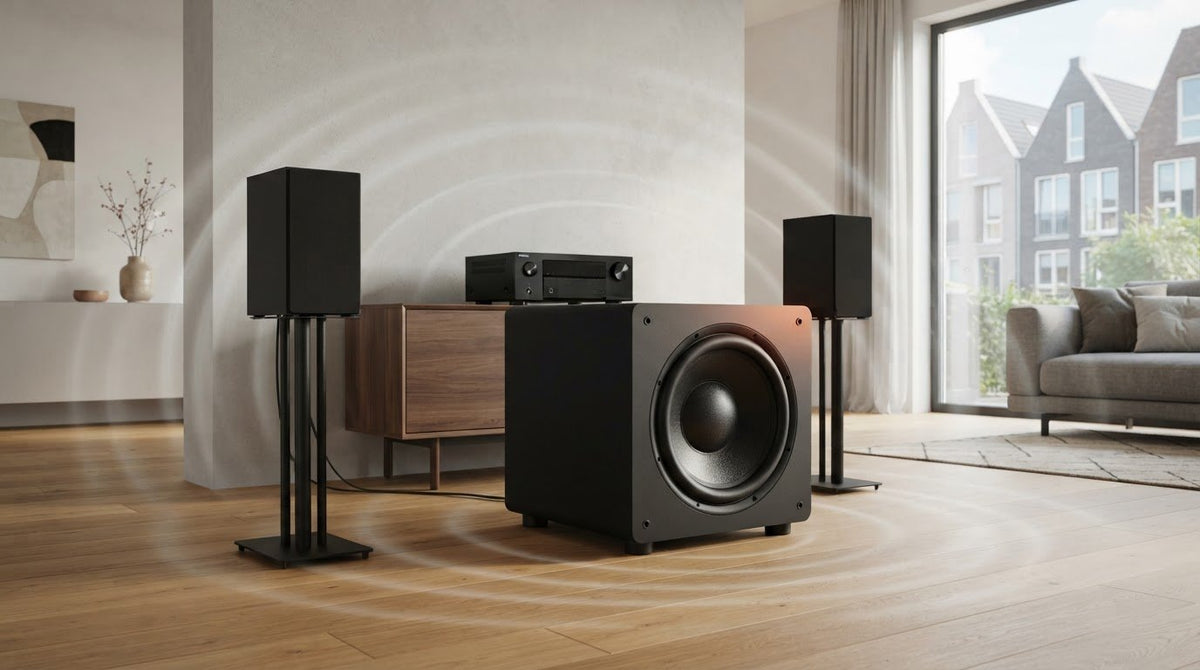
The deepest bass gives movies and music more weight. A bass speaker supplements the bass, usually below about 80 hertz. This gives film effects more depth and a bass line sounds fuller. Which solution is suitable depends on your listening purpose and installation.
Extra bass is not just for spectacular movie scenes. An subwoofer can also complement the low tones in music. Choose a model that matches your other speakers so that the bass is powerful without being overpowering.
In this guide you can read what an subwoofer does and how to choose and adjust an appropriate type for your listening purpose. We explain how active and passive models differ, what to pay attention to with a wireless or wired connection and how to adjust the bass for films, surround and music.
Key points
- Choose active if you want the amplification in the housing; a passive model requires a separate amplifier.
- Compare wireless and wired connections based on the connection that suits your installation.
- Adjust the phase setting and volume to your other speakers for coherent bass.
- Take your listening purpose into account: films, surround and music each require an appropriate balance.
- Use the frequency range and the crossover frequency as guides for selection and adjustment.
Difference between active and passive subwoofers
The main difference is in the amplification. An active subwoofer has a built-in amplifier; a passive model requires a separate amplifier. This partly determines how you connect the subwoofer and how many devices your installation contains. Therefore, first check which outputs your amplifier or AV receiver has. This way you know which type suits your existing system.
An subwoofer can cause noise pollution for neighbors, because low bass tones can penetrate through walls and floors. Limit the nuisance by consciously setting the volume and choosing the location carefully. Listen from your usual seat: if the bass sounds too loud there, lower the level or try a different position. In a shared home, a powerfully set subwoofer is not automatically the best choice.
With an active subwoofer , the built-in amplifier drives the speaker. So you don't have to add a separate amplifier for the bass. This keeps the setup clear, for example if you connect the subwoofer to a receiver and want to limit individual devices. Check whether the receiver can transmit the correct signal. Active subwoofers are practical when you want to keep the amplification in the same housing.
A passive subwoofer does not have a built-in amplifier. You combine it with a separate amplifier that is suitable for the speaker. Assess the amplifier, connections and cabling as a whole. This choice suits an installation for which you want to assemble the reinforcement yourself. The additional equipment requires more attention when connecting and adjusting than an active subwoofer.
Use these steps to choose:
- Check whether your receiver has a suitable output for an subwoofer has.
- Choose active if you want to keep the amplification in the housing.
- Choose passive if you want a separate amplifier use.
- Adjust the connection to your other speakers and available space.
The same basic difference applies in the car. An active car subwoofer has a built-in amplifier; a passive car subwoofer requires a separate amplifier and cabling. Tweeters reproduce high tones, regular car speakers produce the middle and part of the low tones, and the subwoofer the lowest frequencies. Tune the bass to the existing speakers. Otherwise a heavy setting can be used subwoofer sounds too dominant next to original car speakers.
In short: active means built-in amplification; passive requires a separate amplifier. Determine your choice based on your equipment, connections and desired setup. View the different subwoofers for your installation and compare which connection method suits your listening room or car.
Wireless subwoofers
A wireless connection gives you more freedom when placing the subwoofer. You do not have to lay a signal cable from the amplifier to the subwoofer . This is useful if the best spot is not next to your receiver. Just make sure that the subwoofer and the audio system support the same connection method.
For example, wireless subwoofers can connect via WiFi or Bluetooth to an soundbar. A subwoofer with built-in WiFi can pair with an soundbar that also uses WiFi. This way you keep cables out of sight. Wireless does not automatically mean that the subwoofer works with every receiver.
With a wireless connection, the system sends the audio signal to the subwoofer. without a cable. This gives more freedom in placement, but the connection must remain stable. An intermittent signal can cause a delay between image and sound. With a film, for example, you notice that a boom only sounds after the image has already changed.
A wired connection provides a stable signal and prevents delay between audio source and sound. You need a suitable subwoofer cable for this. Consider in advance how the cable runs through the room: along a skirting board, behind furniture or visibly across the floor. This way you can weigh the practical implications of both types of subwoofers before connecting them.
Use these steps to choose the connection:
- See which outputs your receiver or soundbar has.
- Check that the devices support the same wireless connection.
- Choose wired if the cable route is convenient.
- Choose wireless if the cable placement makes it difficult and the devices work together.
- After connecting, test with music and a movie clip for stuttering or delay.
Test a wireless subwoofer on the place where you want to use it. The distance and obstacles between the devices can affect the connection. Play music and then watch a scene with clear low effects. If you hear stuttering or notice a timing difference, try a different location or a wired connection.
Your choice depends on compatibility, cable route and listening experience. View the subwoofers for your setup and compare the connection options with your soundbar or receiver.
Phase adjustment and tuning to other speakers
Good tuning allows the subwoofer to connect to your speakers and the room. Start with the connections, then locate them and listen to how the bass comes together.
Speaker and room tuning
Listen to the bass of your existing speakers first and notice how full they sound in your room. A compact bookshelf speaker may require different support than a floorstanding model. Space also counts: walls, corners and furniture influence the bass at your listening position.
Don't choose based on size or power alone. Determine which content causes you to miss bass, for example music or movies, and adjust the level accordingly. First place the subwoofer in a practical place and listen from your regular seat. Move it if the bass sounds too strong or too weak.
With multiple subwoofers, the coherence between the speakers and the room plays a greater role. A calibration system such as Dirac can help adjust the adjustment to the system structure and room acoustics. Always judge the result from your listening position.
Connect via pre-out, LFE or speaker outputs
Check which outputs your amplifier or AV receiver has before connecting. You can have one subwoofer connect to a subwoofer cable via a pre-out or LFE connection. The LFE connection carries the special low frequency signal for the subwoofer from an AV receiver.
When connecting, follow the designations on the equipment. Connect the output to the corresponding input and route the cable so that it does not pose a tripping hazard. If your installation does not have a suitable output, check which connection options the subwoofer offers. Only use speaker outputs if that connection method is suitable for both devices.
Switch off the amplifier before connecting cables. Please check carefully whether the plugs are firmly attached and the correct outputs are connected to each other. Then turn on the system and test a music fragment or movie scene. Listen for the bass to join in without sounding disconnected from the other speakers.
Phase adjustment and speaker placement
The phase adjustment helps match the output of the subwoofer to that of the main speakers. Start with the basic setting and play a clip in which the bass is clearly present. Change the setting and listen from your usual spot. Choose the position that makes the transition between subwoofer and speakers sound most coherent.
Do not automatically place the subwoofer next to a speaker. Test different places in the same room and always compare from your listening position. Close to a wall the bass may sound different than further into the room. Change one factor at a time, such as placement or phase, so that you notice which adjustment makes a difference.
Finish the adjustment with a familiar piece of music and a movie scene. Check that voices and instruments remain clear while the bass is replenished. If you hear a clear peak or gap in the bass, first adjust the placement and then repeat the phase setting. This is how you coordinate the installation step by step.

Subwoofers for films, surround and music
Your listening purpose determines how you adjust the bass. An explosion may be palpable in a film, while music often requires a steady, controlled bass. An subwoofer usually produces tones lower than about 80 hertz. It therefore complements the lowest frequencies, but should not sound separate from the other speakers.
In a surround setup, the AV receiver processes the special low-frequency signal from films. This includes effects such as rumbling engines and deep explosions. Adjust the level so that moments like these have an impact, without drowning out dialogue or other speakers. For example, play a scene with conversations and a clear bass sound and listen from your regular seat.
Music is mainly about balance and timing. A double bass, bass guitar or electronic bass line must sound powerful and remain recognizable. So don't automatically turn up the volume. Play a familiar song and increase or decrease the level in small steps. This way you can hear whether the low tones support the music or demand attention.
Do you use the same installation for films and music? Then first set a neutral basic level. Then compare a movie scene with a piece of music you know well. An impressive setting for movies can sound too loud for music. With an appropriate setting, the bass remains present without voices, melodies or details disappearing.
A wireless subwoofer with built-in WiFi can be part of a multi-room setup with other WiFispeakers, so that music can be heard in multiple rooms. The devices must be able to work together. Think of a living room where the subwoofer supplements the low tones, while other WiFispeakers play music in a second room.
Adjust your choice to these questions:
- Do you mainly listen to films, music or both?
- Do you want to feel deep effects emphatically, or mainly hear a natural addition?
- Use Do you have a surround system or do you listen with stereo speakers?
- Do you only want music in the living room or also via WiFi-speakers in other rooms?
Test your adjustment with different types of sound. For films, choose a scene with dialogue and low effects; for music, use a song with a clear bassline. Change one setting at a time, such as the level, and listen again from the same place. This way you discover which balance suits your listening purpose, without the low tones dominating the rest of the playback.
Frequency range and low bass tones
The frequency range shows which tones a speaker can reproduce. An subwoofer typically plays frequencies below about 80 hertz. That is a useful starting point, but also look at the lower limit: it indicates how deep the low tones can go.
A specification of 20 hertz to 20 kilohertz does not always tell the whole story. Many ordinary speakers cannot properly reproduce tones below 40 hertz, even if that range is stated on paper. An subwoofer that can handle those lower frequencies can therefore audibly fill in where your main speakers fall short.
When comparing, pay attention to the entire frequency range, not just one impressive number. A model that reproduces low frequencies can complement deep cinematic effects or an electronic bassline. The sound also depends on your room, its placement and the connection to your other speakers. Specifications help compare models, but do not independently tell you what the whole thing sounds like in your listening room.
The crossover frequency determines where the playback from your main speakers transfers to the subwoofer. About 80 hertz is a reasonable starting point. Adjust the transition to the speakers you use. Small speakers may require a different setting than large floorstanding models. Listen to familiar music and reduce or increase the crossover until the bass sounds natural.
A crossover frequency that is too high can cause the subwoofer to also produce tones that sound better from your regular speakers. Too low a setting can actually cause an audible gap. Therefore, adjust step by step: first change the crossover frequency, play the same fragment again and pay attention to the transition between the bass line and the midrange.
With electrostatic speakers, the selected cut-off frequency may be higher. A setting from 200 hertz to the subwoofer is often used for this. Also look at the resonance frequency of the speaker: for the combination with an subwoofer it should be lower than 40 hertz. Use these values as technical considerations when assembling the set.
Use this quick check when choosing:
- Compare the lowest frequency to the range of your main speakers.
- Use approximately 80 hertz as a starting point for the crossover.
- Test the transition with the same piece of music or movie scene.
- Adjust the setting when the bass sounds loose or disappears.
View subwoofers with a suitable frequency range and compare the specified lower limit with your speakers. This way you can choose deep bass tones that suit your installation, without just relying on the lowest number in the specifications.
OrangeAudio: bookshelf speakers
OrangeAudio helps you put together a suitable speaker setup with Bookshelf Speakers, Floor-standing Speakers, Active speakers and built-in speakers. Are you looking for compact speakers for music and movies? Bookshelf models can form a good basis, while an subwoofer complements the lowest tones. Adjust the combination to your room, amplifier and listening purpose.
Do you want less separate equipment or an installation that blends in with your interior? Then view the Active speakers or Built-in speakers. Compare the options and consider whether you mainly listen to music, movies or both. This way you can choose a setup that suits your system and your living room.
Discover the options at OrangeAudio and contact us for advice about your speaker choice. You can also visit orange-audio.com .
Complete your listening room
The next step is to determine how the bass fits within your entire setup. Consider not only the desired sound, but also your speakers, amplifier and the available space. This way you prevent an individual choice from not fitting in well later. For example, a setup with Bookshelf Speakers may be different from a system with Floor Standing Speakers or Active Speakers.
OrangeAudio offers different types of speakers in addition to subwoofers. Compare the options based on your listening purpose: do you mainly want to experience films, listen to music or combine both? Also take into account the available space and the equipment you already use. This way you can determine more precisely which combination suits you.
Take a look at the offer and choose a next step that feels good. Discover the subwoofers and find a suitable basis for your listening room. If you have any questions about the combination with your speakers or amplifier, please contact OrangeAudio. This way you can build an installation at your pace that you enjoy listening to.
Frequently asked questions
What is a subwoofer?
A subwoofer is a speaker that is specially intended for the lowest tones in music and movies. It complements the playback of your regular speakers, so that, for example, a bass guitar or film sound has more depth. Think of it as part of a complete set, not as a replacement for your main speakers. The right choice depends on your equipment, listening room and desired sound balance.
When does your audio system need an subwoofer ?
A subwoofer can help if your installation does not convincingly reproduce the lowest tones or if you want to give films more tactile depth. For example, listen to a song with a clear bassline and notice if it sounds thin. In a TV setup, an subwoofer can supplement the bass that the built-in speakers lack. If the bass already sounds full and even, you don't need to add anything.
What is a subwoofer and how does it work?
A subwoofer converts the electrical audio signal into movement of the speaker cone. This movement causes air to vibrate and makes low tones audible. With an active subwoofer , the built-in amplifier provides the drive; a passive model receives amplification from a separate amplifier. The receiver or soundbar determines which low-level information is forwarded. That is why both the connection and the settings are important for the final display.
Which subwoofer suits my living room, TV or music system?
First choose based on the equipment you already have. Check whether your TV system, soundbar, amplifier or receiver supports a suitable connection or wireless link. Then look at the available space and the speakers you are using. A compact living room requires a different practical setup than a spacious room with floor-standing speakers. Adjust your choice to your listening purpose and the desired amount of bass.
How many watts and what frequency response do I need for a subwoofer?
There is no universal wattage that is suitable for every room and installation. The power provides information about the amplification, but does not only determine how the bass sounds. Also compare the frequency range with that of your main speakers and pay attention to the lowest frequency displayed. A specified range helps with comparison, but placement, adjustment and the characteristics of your room also influence what you hear.
How do I connect an subwoofer to an amplifier, soundbar or receiver?
Use a connection that supports both your equipment and the subwoofer . For example, a receiver may have a pre-out or LFE output that you connect with a subwoofer cable. With an soundbar , a wireless link can work if both devices are suitable for it. Switch off the equipment before connecting cables. Then check the selected input and play sound to hear whether the bass is coming through.
Where do I place an subwoofer for the best bass in the house?
Start in a place where power and connection are accessible and the housing does not hinder your walking route. Then listen to a well-known piece of music or film fragment from your regular seat. Move the subwoofer and compare the bass from the same spot each time. Walls, corners and furniture can change the sound. Choose the position where the bass sounds even and matches the rest of the playback.
How do I adjust the crossover, phase and volume of a subwoofer ?
Start with a quiet volume and adjust the crossover frequency on your main speakers. Then play a familiar piece of music and increase the level until the bass complements the sound without overpowering the melody. Then adjust the phase setting and compare the sound from your seat. Always change one setting at a time. This way you discover which adjustment makes the transition between the speakers sound most natural.